
Cruelty to wild animals can take many forms and is often not obvious to the casual viewer. Many of the worst examples – elephant riding, civet coffee tours, for example – are commonly offered to tourists in the countries in which they take place and might appear to be traditional aspects of their cultures.
What this list reveals is that anyone considering going to an experience that involves captive wild animals should investigate whether there are any issues they ought to bear in mind before they do so.
Dolphinariums

Animal welfare organisations say the space given to dolphins in captivity is roughly 200,000 times smaller than what they would enjoy in the wild, so the idea that dolphinariums can in any way be humane, they argue, is absurd. Though there are now none in the UK, there are still plenty in Europe, including in France, Germany, the Netherlands, Spain and Sweden. According to the European Commission (in 2020), there are 33 dolphinariums holding 280 individual animals, and there have been calls for the EU to draw up proposals to phase them out.
Walking with lions
Aside from the fact that lion cubs are separated from their mothers at an early age, the biggest problem with walking with lions experiences are what happens to the animals once they become too old to be trusted with visitors. The chances are they will be sold to a canned hunting operation, where lions are hunted and killed in small enclosures. It may also be that the the bones of dead animals are sold to countries in the Far East, where they are made into products with allegedly medicinal powers.
Riding elephants
There are a number of problems with elephant riding experiences. First, it is likely that the elephants have been taken from the wild, because it is very hard to breed Asian elephants in captivity, says the welfare group Animals Asia. Second, notoriously cruel methods are involved in training elephants to be ridden, and this involves tormenting them so they learn to be scared of humans. Last but not least, in some countries such as Vietnam, it’s reported that many elephants die of exhaustion and malnutrition.
Performing orangutangs
In attractions across south-east Asia, captive orangutans are trained, using brutal methods, to take part in shows where they have to ride bikes, perform with hula hoops and box each other. Tourists can also have pictures taken with these normally solitary great apes.
As with Asian elephants, most are taken from the wild – poachers kill mothers with young, and then take the offspring to sell. The authorities in Thailand are not ignorant of the abuses that take place at these locations, having confiscated 115 orangutans from one facility in 2004 after tests proved they had come from the wild in Indonesia, and yet they still continue.
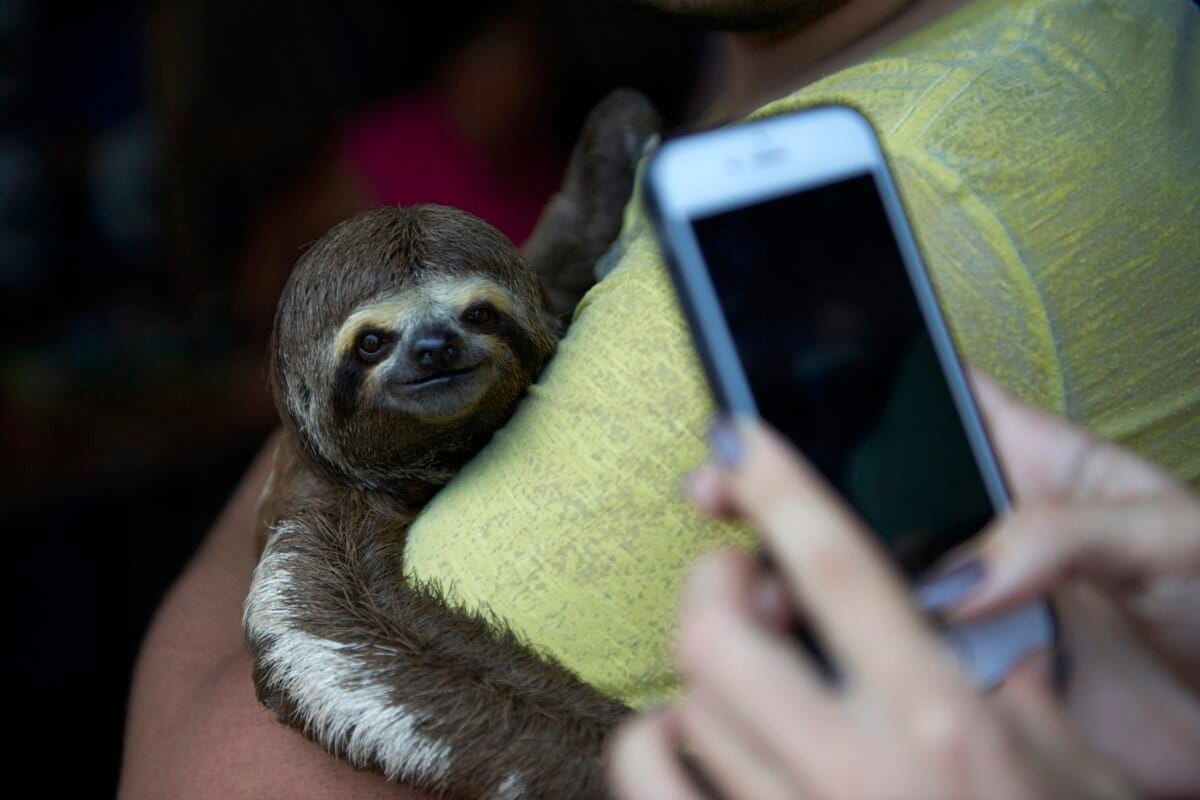
Sloth selfies
The trend for selfies arrived in South America later than in Asia, but now it has caught on, some disturbing trends have been exposed. Investigations by World Animal Protection have shown how species including sloths, giant anteaters, anacondas, toucans and even caimans are taken from the wild so that tourists can pose with them. Research carried out in Manaus in Brazil and Puerto Alegria in Peru found sloths rarely survived for more than six months, while caimans were restrained with rubber bands around their jaws.
Civet coffee plantations
In numerous countries in South-east Asia, tours of civet coffee plantations have become popular. But the reality is grim: the civets – normally solitary, omnivorous creatures that eat a wide range of foods – are kept in small cages and fed a monotonous and unhealthy diet of coffee cherries, which are then defecated out as beans after being digested.
These beans are turned into a luxury, novelty coffee that sells for huge sums in the West. Despite assurances from many coffee wholesalers and retailers that the civets are kept in humane conditions, the reality is they suffer from malnutrition and other ailments as a resulting of the forced captivity.
Snake charming
Snake charming might appear to be a cultural tradition of Asia and North Africa but according to the tour group Explore, the reality is that in countries such as Morocco, it is a money-making venture based on cruelty to the snakes.
In order to make the activity safe, snakes may have had their fangs removed and they can even have their mouths sewn shut with just enough room for their tongue to be able to flick in and out. Snakes rise to the sound of the flute because they have been trained to expect food, and the upright posture suggests they feel threatened.
Tiger selfies
There are thought to be more than 800 tigers in zoos in Thailand alone, and many of them offer what they call “once-in-a-lifetime” opportunities for visitors to have their photos taken with them. Sadly, there is great cruelty attached to the industry – cubs are separated from their mothers when they are just a few weeks old, and half the tigers observed in a report drawn up by World Animal Protection were contained in enclosures of less than 20 m2, while 10 per cent of tigers showed behavioural problems.
Captive bears
Bears can end up in cruel confinement in a number of ways – zoos, clearly, but also circuses, farms (where they are kept for their bile) and also (though rarer than it used to be) as ‘dancing’ animals. The welfare group Bear Conservation says bears are “highly intelligent, wide-ranging animals” that suffer badly in captivity and frequently display abnormal behaviour such as repetitive pacing and swaying from side to side. Another group, Wild Welfare, has found 400 animals being held in barren, concrete enclosures in bear parks in Japan, and the bears trained to perform in shows.
Circuses
Though the use of wild animals in circuses was banned in the UK by legislation passed in 2019 (and has been elsewhere around the world, too), there are still many countries that permit it. It is still legal in many US states, and the Born Free Foundation says animals, including elephants, lions and tigers, perform as a result of fear and are confined to tiny cages or kept in chains for most of their lives. Numerous circuses, it warns, have been cited for not adhering to the minimum standards set out in US legislation, including failing to provide fresh food and water, sufficient space and adequate veterinary care.
This article by James Fair was first published by Discover Wildlife on 30 May 2025. Lead Image: Getty.
Wildlife in catastrophic decline
The 73% decline in vertebrate wildlife populations during the last 50 years (mammals, birds, amphibians, reptiles and fish), is primarily driven by human activities that threaten biodiversity.
Habitat Loss and Degradation – human activities like deforestation, urbanization, and agriculture have led to the destruction and fragmentation of natural habitats, reducing the space and resources available for wildlife.
Pollution – air, water, and soil pollution from industrial activities, agriculture, and other sources can harm wildlife directly or indirectly by affecting their habitats and food sources.
Climate Change – changing weather patterns, rising temperatures, and sea levels are disrupting ecosystems and impacting species’ ability to adapt and survive.
Overexploitation of Resources – unsustainable hunting, fishing, and logging practices can lead to the depletion of populations and the loss of biodiversity.
Invasive Species – the introduction of non-native species can disrupt ecosystems, compete with native species, and threaten their survival.
Help to protect wildlife by donating as little as $5. Our conservation partners spend at least 80 percent of the money raised on actual fieldwork rather than administration and fundraising.




Leave a Reply