
The Victorian government sat on a report for more than 12 months that found the state’s koala population was in chronically poor health.
The review of the state’s koala populations, led by state science agency the Arthur Rylah Institute in conjunction with scientists from major universities, was completed for the Victorian government in June 2025.
It estimated there were 217,000 koalas in the state in 2023 and 224,800 in 2024 – a dramatic drop from past estimates of 460,000, which the report attributed to different survey and modelling methodology, rather than an actual population decline.
As part of the research, scientists conducted health and disease assessments on 68 koalas, with 29 of the koalas (43%) found to be in such poor health they “were euthanised on welfare grounds”.
The report warned the surveys found “a higher-than-expected proportion of koalas from seven geographically distinct regions in a state of chronically poor health and welfare”.
The government published the report on Wednesday morning as the new environment minister, Jaclyn Symes, announced $2.6m for koala conservation, including for habitat restoration and research into koala health and genetics.
Leanne Wicker, a wildlife veterinarian who was one of the authors on the report, said researchers had been shocked by the poor health of some of the koalas they found in the field.
“While we were doing this research we knew we were seeing something that urgently needed attention and understanding,” she said. “And it’s been very difficult to get the support and resources needed because the report hadn’t been made public.”
She said the overabundance of certain local Victorian koala populations – such as those at French Island and in western Victoria – had created a perception that the state’s overall koala population was thriving. “What we’ve missed is we have a crisis in our koala populations in Victoria because we have a very concerning level of poor health and welfare.”
Deakin University’s Desley Whisson, another author on the report, said while the 2024 population estimate of about 225,000 koalas “seems like a lot, most of those koalas are in areas where there are high densities of animals”.
“There’s large parts of the state where koalas occur at low densities and are probably in poor health,” she said.
She said the government needed to turn its attention to areas with low numbers “because we could be losing koalas in some parts of the state without even knowing”.
The report used systematic visual and acoustic surveys in 2023 and 2024 to monitor koalas at 182 sites. That data was then used to estimate the overall abundance and distribution of Victoria’s koala population.
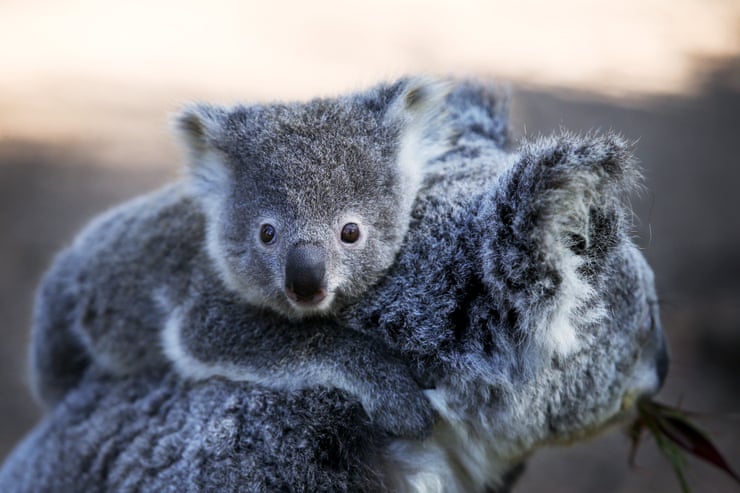
This article by Lisa Cox was first published by The Guardian on 9 September 2026. Lead Image: An overabundance in some local koala populations had created a perception that Victoria’s overall population was thriving, researchers say. Photograph: Penny Stephens/The Guardian
Protect Wildlife Before It’s Too Late
Whether you choose to make a one-time gift or a monthly subscription, you provide the critical funding needed to protect wildlife.
Your immediate support makes a life-saving difference.



Leave a Reply