
Afew dozen large nests appear in the mist of equatorial dawn, half-hidden behind a tangle of vines and leaves.
That is where the bonobos sleep, 12 metres above the ground. But it has rained all night, and the primates are in no hurry to get up.
It is 6.30am when the first head emerges. It gives a cry, a sharp bark, and another silhouette unfolds from its cocoon of branches.
And then another. Within five minutes, the whole group is awake – yawning, stretching, straightening.
Their features are fine, their limbs long and delicate, their build less stocky than that of chimpanzees, their closest cousins.

Bonobos live on the left bank of the Congo River, while chimpanzees spread along the right bank, extending their range from here in the Democratic Republic of the Congo to Tanzania in east Africa and Cameroon in the west. The two species diverged about 1-2 million years ago, when a few groups of chimpanzees are thought to have crossed the river, probably during a period of exceptional drought.
Those early migrants evolved differently: chimpanzees on the right bank developed male-dominated societies, sustaining traditions of collective hunting and recurring conflict with other groups. Among bonobos, females are the dominant sex, and their societies are less aggressive and more peaceful. When primatologists began studying them in the wild in the 1970s, they noticed how conflict was often defused by brief sexual encounters. The press of the day dubbed them “hippy apes”.
It was around the village of Wamba, just north of the equator, that scientific research into these primates first began. The Japanese primatologist Takayoshi Kano set up the first observation post there in 1973. A second was opened the following year at Lomako, farther west, and a few others followed. Today, four sites remain active: Kokolopori, LuiKotale in Salonga national park, Lomako-Yokokala and Wamba.
Over the past 50 years, studies at these sites have revealed the distinctive traits of bonobos: the dominant role played by females in social organisation; the function of sex as a lubricant for daily interactions; their tolerant nature, heightened emotional sensitivity and willingness to cooperate, which reveals an astonishing capacity for empathy – qualities once thought absent from the animal kingdom.
This year, a study carried out in the community reserve of Kokolopori and published in Science in April found that bonobos were capable of combining vocalisations in complex ways, much like the structuring of human language. “This discovery challenges what we thought we knew about animal communication and the supposed uniqueness of human language,” says American conservationist Sally Coxe.
In 2002, Coxe helped protect part of the Kokolopori forest with the Bonobo Conservation Initiative (BCI) NGO, working with the local organisation Vie Sauvage to safeguard the last remaining bonobos there – and to study them, in partnership with Harvard University.
Yet, 20 years on, the protected area and research it facilitates face the same obstacles: almost no roads or electricity, and infrastructure is collapsing. The DRC remains one of the five poorest nations in the world, despite its immense deposits of copper, cobalt, lithium and coltan. According to the World Bank, three out of four Congolese people live on less than $2.15 (£1.60) a day.
“Since the 1990s the roads have not been maintained, vehicles can no longer use them,” says Mbangi Aringo, the most senior tracker in Kokolopori forest. “If we want to sell our crops, we have to carry them on foot or by bicycle.” Now in his 50s, he says: “If BCI had not paid me a salary to observe the bonobos, I would have become a farmer and struggled to feed my family, or I would have had to hunt in the forest. I would have had no choice.”
Against this backdrop, bonobos – one of the DRC’s most emblematic species – are increasingly threatened by human activity, above all poaching and deforestation, which gnaw away at their habitat year after year. “We estimate the population at fewer than 20,000 individuals,” says Takeshi Furuichi, director of research at Wamba and a professor at Kyoto University. “Perhaps even fewer than 15,000. They are now critically endangered.”
In an attempt to slow the erosion of habitat, the government and conservation organisations have been exploring the possibility of “bonobo credits”. Modelled after carbon credits, the programme would give money for infrastructure to communities that prevent hunting of bonobos and keep their forests standing.
We want to bring people and nature closer together
Jef Dupain
Primateologist Jef Dupain, director of the Antwerp Zoo Foundation in Kinshasa, has been involved for decades in bonobo conservation and research and is working in partnership with the Congolese Institute for Nature Conservation on the pilot scheme. Their aim is to create a mechanism giving local people a direct stake in protecting wildlife. “I wanted local residents to gain real income from conservation,” he says.
“Villagers who commit to respecting bonobo habitat have begun receiving monetary compensation, in the form of funding for infrastructure. The aim is to create a harmonious balance, involving civil society as a whole, unlike the older conservation model, which sought to wall off areas of biodiversity when they came under threat. We want to bring people and nature closer together.”
At a roundtable discussion on bonobo credits, DRC president Félix Tshisekedi said it was an opportunity to flesh out the country’s proposal for “the creation of a biodiversity credit specific to each species, particularly emblematic species of high value to humanity such as the bonobo”.
For those working on the ground, protecting bonobos’ last remaining habitats is crucial. “There is still much to learn from them,” Coxe says. “Their use of medicinal plants in the forest, and what humans may have learned from them in this regard. But also their communication – verbal and nonverbal – and the ways they respond to threats from humans, such as poaching.”
Furuichi agrees. “Before the 1970s, the bonobo was still regarded as an unknown primate,” he says. “The discoveries made over the past five decades have helped us to better understand the evolution of humankind.”
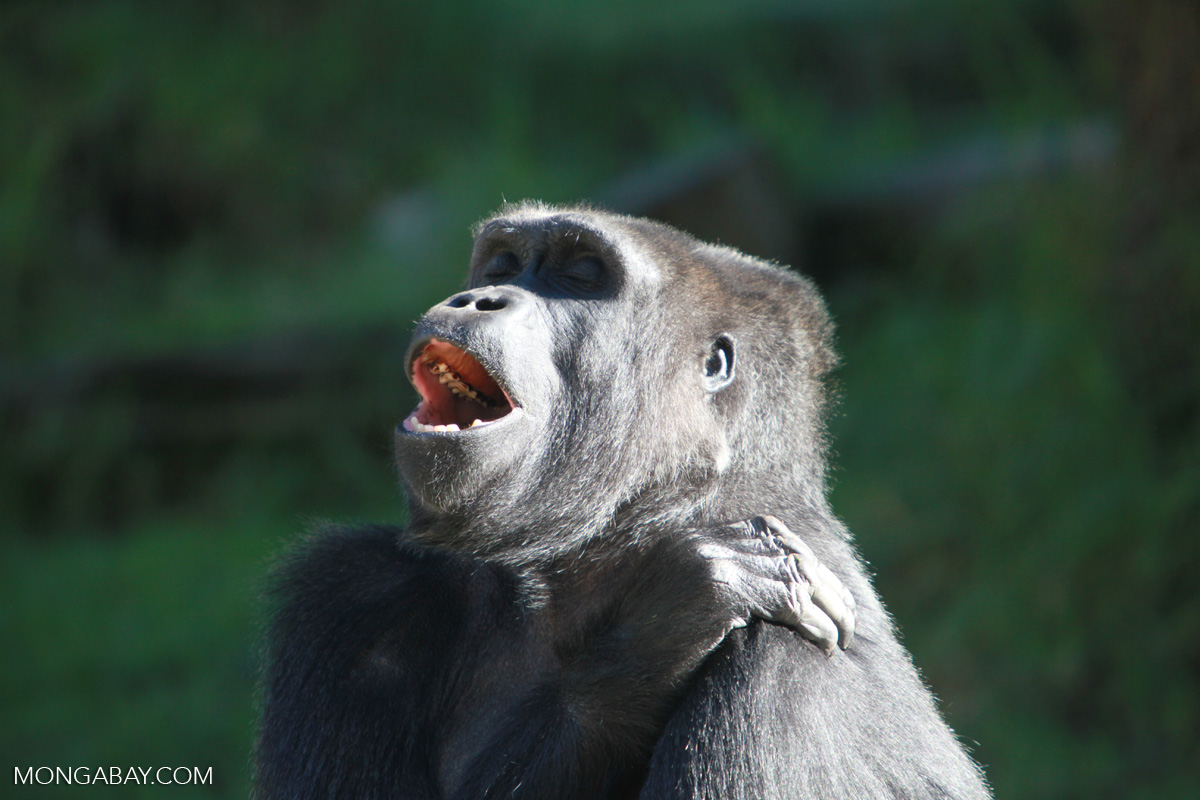
This article by Guillaume Jan was first published by The Guardian on 19 October 2025. Photos by Gwenn Dubourthoumieu. Lead Image: A study of bonobos in the Kokolopori reserve has found they are capable of combining vocalisations in complex ways, much like humans.
What you can do
Help to protect wildlife by donating as little as $5 – it only takes a minute!
Our conservation partners spend at least 90 percent of the money raised on actual fieldwork rather than administration and fundraising.




Leave a Reply