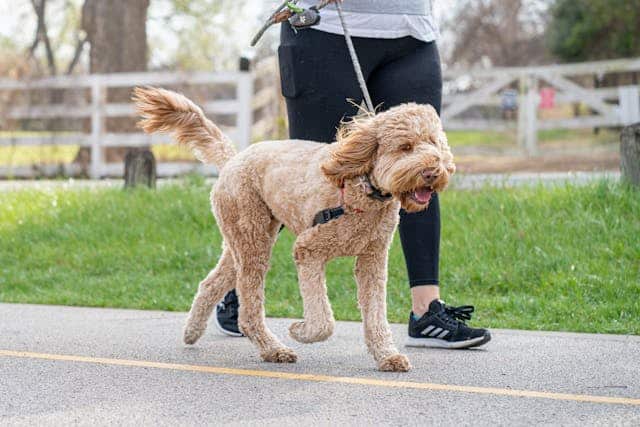
Picking the right leash for your dog is harder than it looks.
The wrong one can turn a peaceful stroll into a dangerous situation for you and your pup. Big dogs snap thin leads. Small dogs get lost in bulky ones. And somewhere in between, you end up with sore wrists, tangled legs and a dog that won’t listen.
Here’s the good news:
Once you understand how dog size affects leash choice, the rest becomes easy.
Here’s how to get it right…
Inside this guide:
- Why Leash Size Actually Matters
- Leash Lengths Explained
- Matching Leash Width to Dog Size
- Material Choices That Hold Up
- Safety Tips Every Owner Should Know
Why Leash Size Actually Matters
A dog walking leash is not just a length of rope with a clip on the end.
It’s the personal bond between you and your dog. And when that bond breaks — bad things happen. Dog walking injuries more than quadrupled from just under 7,200 in 2001 to over 32,000 in 2020. And that number rises every year.
What causes most of these injuries? Dogs pulling. Leashes tangling. People tripping.
Walking your dog can be vastly improved with a high quality leash from a reputable brand such as https://bravowalk.com/. A high quality dog walking leash is one that you are in control with, has some give for jerky pulls, and one that holds your dog securely without causing pain or discomfort. If you don’t have the correct leash, you are battling your dog every step of the way.
Want to know the scariest part?
Most owners never think about leash size until something goes wrong.
The right dog walking leash should match:
- Your dog’s weight and strength
- Your walking style
- The environment you walk in
- Your dog’s training level
Get those four things right and walking your dog will be the highlight of your day — not a safety hazard.
Leash Lengths Explained
Leash length changes everything about how you walk your dog.
Short leashes (4 feet): Ideal for large powerful dogs that need to be kept in close control. These leashes keep your dog tight to your side and restrict the momentum your dog can gain before reaching the end of the leash.
Standard leashes (6 feet): By far the most popular and a good choice for most dogs. They give your dog plenty of room to explore with their nose without being out of control.
Long leashes (10 to 30 feet): These are good for training and recall work. Not recommended for use on a regular walk, as they get easily tangled around legs and objects.
Retractable leashes: Very popular. But many are against them. They can suddenly break. They offer very little control if your dog lunges.
The consensus of professional opinion is that the standard non-retractable leash should be 6 to 8 feet long for regular walks. Extra-long leads become easily knotted. Retractables tend to malfunction at the critical moment.
Matching Leash Width to Dog Size
This is where most dog owners get it wrong.
Choosing a leash width should be done according to your dog’s strength. Too thin and it’ll break. Too thick and it’s hard to grip.
Here’s the simple breakdown:
Small Dogs (Under 25 lbs)
Toy and small dogs, such as Chihuahuas, Yorkies, and Dachshunds, require lightweight leashes. 3/8 inch is often ideal. Anything wider will weigh them down and feel bulky on their slender frame.
Medium Dogs (25-60 lbs)
Beagles, Cocker Spaniels and Border Collies are in this group. 5/8 inch width is strong enough without being too heavy — a happy medium that is good for most breeds.
Large Dogs (60-90 lbs)
Labradors, German Shepherds, and Golden Retrievers need a beefier leash. Aim for about 3/4 inch or 1 inch in width. These strong dogs can break thinner leads when riled up.
Extra Large Dogs (90+ lbs)
Great Danes, Mastiffs, and Saint Bernards require extra-heavy duty leashes. Opt for 1 inch minimum. Pulling force can be tremendous — researchers recorded pulling events of over 400 Newtons, or about 90 pounds of instantaneous force.
Material Choices That Hold Up
The material of your dog walking leash is just as important as the size.
Nylon: Inexpensive, light weight, available in many colours. The bad? Rope burns when your dog jerks suddenly and slips through your hands.
Leather: Very durable, comfortable, and actually softens with time. Works well on medium to large dogs. Expensive and doesn’t like water.
Rope: Rope leashes are climbing-style ropes that are easy to grip and very strong. They are good for strong, large dogs that pull a lot, as they absorb some shock.
Bungee/Shock-absorbing: These have a stretchy part to absorb jerks. They are great for minimizing the impact of lunges/jumps and reducing stress on wrists and shoulders.
Chain: A bad choice most of the time. Heavy, uncomfortable, can injure hands when the dog is pulling.
A padded rope leash or bungee-style lead is the safest option for most medium/large dog owners.
Safety Tips Every Owner Should Know
Even the best leash won’t save you if it’s being used wrong.
Here are the key safety practices every dog owner should follow:
- Never wrap the leash around your hand or fingers. Sudden pulls can fracture fingers and crush hand bones.
- Hold the leash firmly in your palm. This gives control without risking injury.
- Stay off your phone. Distraction causes a huge number of walking injuries.
- Check the clip regularly. A worn clip can open unexpectedly.
- Match your harness to your leash. A no-pull harness with the leash clipped to the chest offers way more control than a back-clip or collar.
One more thing to keep in mind…
Dog walking injuries disproportionately affect some demographics. Statistics indicate that older adults and women are at greatest risk due to improper leash gear for their dog. Choosing an appropriate dog walking leash is one of the simplest ways to not be a part of those statistics.
Final Thoughts
Selecting the appropriate dog walking leash size for your dog isn’t difficult — but it is important.
A lot.
Start with the basics:
- Match the leash width to your dog’s weight
- Pick a length between 6 to 8 feet for daily walks
- Choose a material that fits your dog’s pulling strength
- Skip retractables for strong or reactive dogs
A proper dog walking leash ensures your safety, your dog’s security, and a more pleasurable walk every time.
Don’t wait until an injury happens.
Look at your leash right now. If it’s the wrong size, the wrong material, or has any wear and tear — get a new one. Your dog (and your wrists) will thank you.

Leave a Reply