
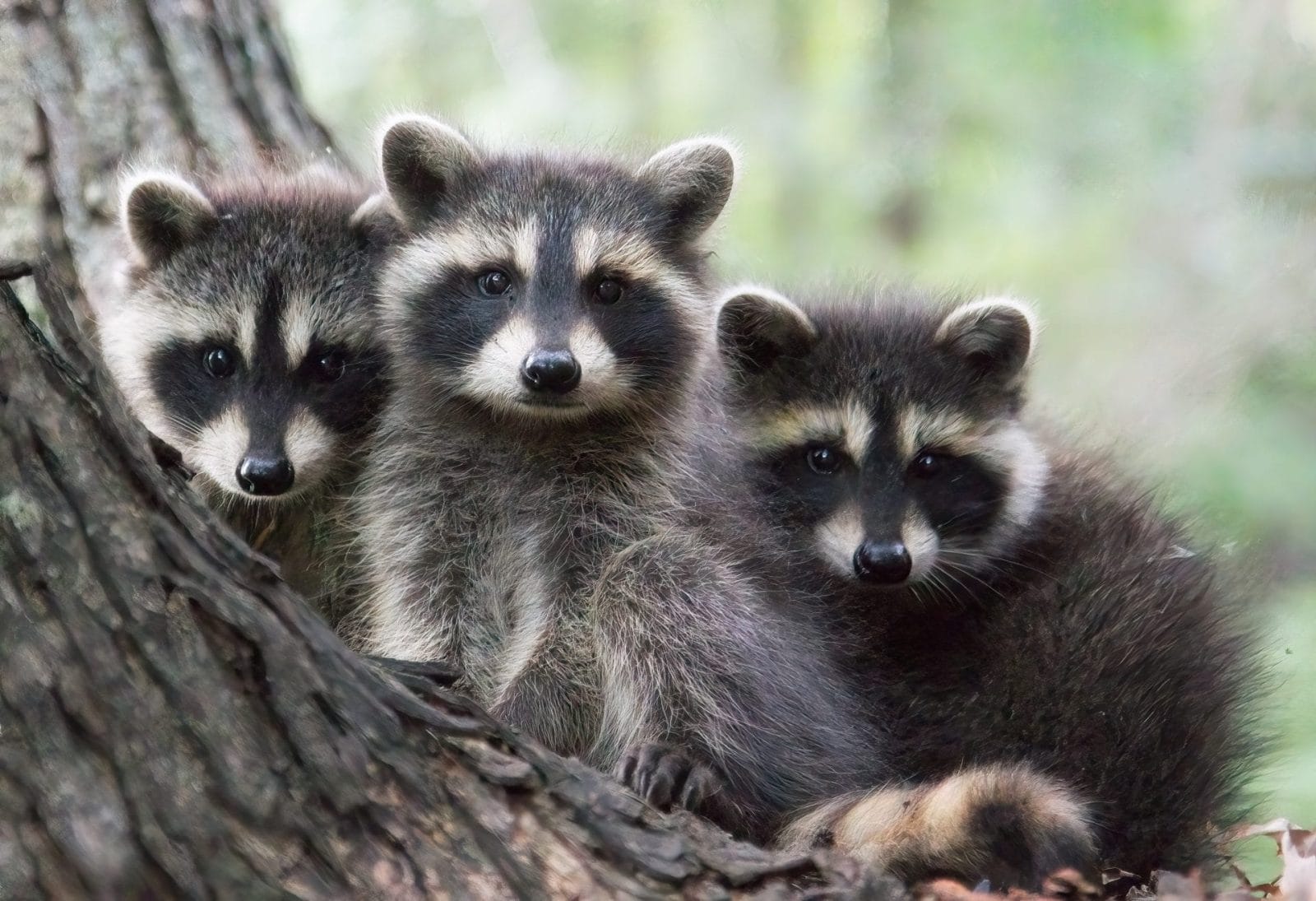
Raccoons living wild in cities in the United States are beginning to show physical changes that resemble early signs of domestication, according to a recent study.
The study found that urban raccoons had developed shorter snouts than rural raccoons, with the research produced by the University of Arkansas at Little Rock and published in Frontiers in Zoology. This is an example of a physical trait that appears across domesticated animals that have adapted to living in close proximity to humans over long periods of time, along with other traits such as smaller teeth, curlier tails, smaller brains and floppier ears.
“I wanted to know if living in a city environment would kickstart domestication processes in animals that are currently not domesticated,” said the study’s lead author, Dr Raffaela Lesch, an assistant professor of biology at the University of Arkansas at Little Rock. “Would raccoons be on the pathway to domestication just by hanging out in close proximity to humans?”
To find out, Lesch and her team analyzed nearly 20,000 photos of raccoons uploaded from the US to iNaturalist, a community science platform. They concluded that, across the country, raccoons living “in close contact with densely populated human environments experience a reduction in snout length” and observed a “3.56% snout reduction between rural to urban raccoons”.
The paper argues that the domestication process across species begins with the “adaptation of a subpopulation to a new environmental niche in the human environment” and states that “the combination of the ready availability of refuse, ie, food scraps, and the absence of large predators make the human environment a niche of great potential.”
When it comes to raccoons, Lesch said that “trash is really the kickstarter.”
“Wherever humans go, there is trash” Lesch said. “Animals love our trash. It’s an easy source of food. All they have to do is endure our presence, not be aggressive, and then they can feast on anything we throw away.”
It’s no accident that raccoons living and breeding in cities are nicknamed trash pandas.
Lesch said, in a statement emailed to the Guardian earlier this week, that “in order to best take advantage of this human-centered niche” the animals have to be “bold enough to access resources yet nonaggressive enough to avoid being culled from the population”.
This, Lesch said, “creates distinct selection pressures favoring friendly and tame individuals”.
The study cites research that suggests that raccoons with “dampened” flight-or-fight responses, that are calmer and less aggressive around humans, are more likely to succeed in these built-up environments, and that this can lead natural selection toward greater “tameness”.
The shift in selection, the research suggests, has led to changes in the animal’s neural crest cells, which are the cells that help form the skull, facial bones and other traits, leading to a variety of physical and behavioral changes.
These findings, Lesch said, “support the Neural Crest Domestication Syndrome hypothesis”, which states that selection pressure for tameness affects early embryonic development. This, Lesch said, has the “potential to explain” the combination of traits linked to domestication, including shorter snouts.
According to a news release, this selection toward “tameness” as well as the “access trash”, leads to “a trickle-down in development, resulting in traits like shorter snouts, which are common in domesticated animals like dogs”.
In the study, the researchers also pointed to similar findings that have been documented in the United Kingdom with red foxes, where foxes living in London were found to have shorter, wider muzzles than rural foxes. In that study, the researchers found that a shorter and wider snout “may be advantageous in an urban habitat where resources are more likely to be accessed as stationary patches of discarded human foods”.
Stanley D Gehrt, a professor of wildlife ecology at Ohio State University, described the new raccoon study, in an interview with the Guardian, as “very interesting” and said that the findings fit “with a lot of the other things that we’ve learned about how these animals are affected or how they adapt to urbanization”.
Urbanization for some species, he noted, can strongly influence their behavior, body and their population dynamics.
“We’ll have to see with more evidence and with other studies if it’s actually a pathway to domestication or not,” Gehrt added.
Arina Hinzen, the founder and executive director of the Urban Wildlife Alliance, a non-profit “dedicated to the welfare of New York City’s wildlife” called the study “a fascinating piece of work and a clever use of citizen science”.
Her main takeaway was that “city life is not only changing raccoon behavior, but it is also starting to show up in their bodies as well.”
She said that her group had not directly “noticed the physical changes”.
But she added: “As someone who works with urban wildlife in New York City, I see raccoons that are highly habituated to people and human environments,” Hinzen said. “They routinely feed in trash, navigate buildings and streets, and show a much calmer response to people and dogs than truly wild raccoons.”
This article by Anna Betts was first published by The Guardian on 28 November 2025. Lead Image: A raccoon jumps over a fence in Central Park in New York on 16 April 2020. Photograph: Johannes Eisele/AFP via Getty Images.



Leave a Reply