
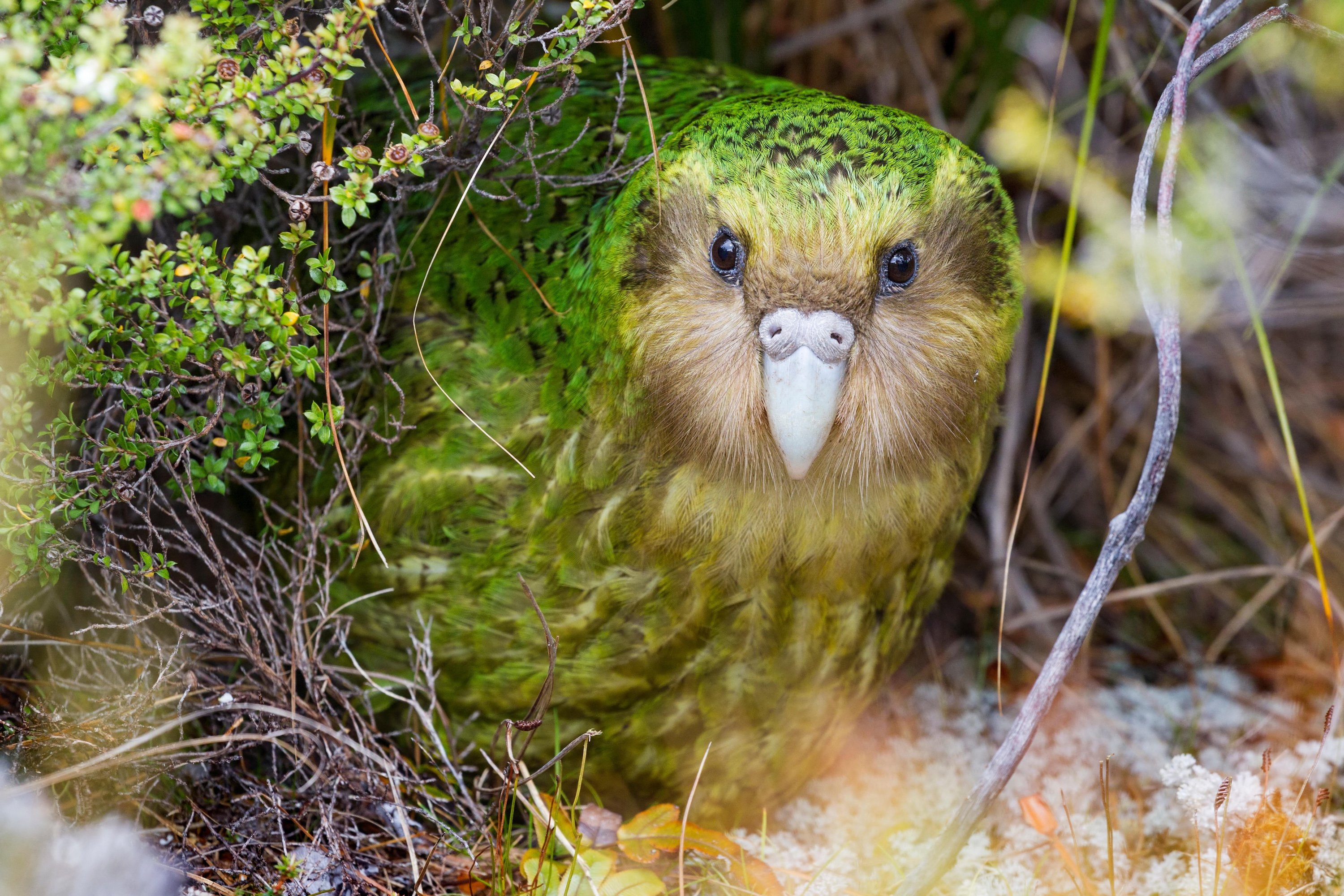
A total of 59 healthy kākāpō chicks have hatched over the last few weeks, according to the latest tally by Aotearoa New Zealand’s Department of Conservation. This marks one of the most successful recent breeding seasons for this critically endangered bird, whose last breeding season was four years ago.
The kākāpō (Strigops habroptilus), a flightless bird in the parrot family endemic to Aotearoa New Zealand, has a total population of 236 adults, up from a low of just 51 individuals in the 1990s. Around the same period, the surviving birds were relocated to three predator-free Aotearoa New Zealand islands — Whenua Hou, Pukenui and Te Kākahu-o-Tamatea — but they’ve still struggled with low reproduction rates.
“Every new chick brings the species further from the brink of extinction,” Deidre Vercoe, the Department of Conservation’s operations manager for kākāpō, told Mongabay by email. “There’s always a sense of hope and optimism for the future.”
Kākāpō only breed in years when the native rimu (Dacrydium cupressinum) tree produces a heavy crop of fruits, which happens every 2-4 years.

So far this year, 140 fertile eggs have been identified and 52 healthy chicks were born, with an extra seven chicks assumed via remote technology. The data are shared with the public every Friday, with an uploaded photo of the tally written in marker on the department’s refrigerator.
Though more chicks may hatch over the next days and months, they likely won’t all survive. The breeding season record was in 2019, with 73 fledglings.
“Success is not just about the number of new chicks. We want to create healthy, self-sustaining populations of kākāpō that are thriving, not just surviving,” Vercoe wrote.
“Kākāpō are among the most intensively monitored species on the planet, and while numbers are so low, intervention to ensure the best chance of success has been critical,” she added. “As the population grows, we will begin to step back on some of the more hands-on management so we can begin to understand what a more natural level of survival looks like.”
The long-term goal is to restore the species to parts of its former range across New Zealand. Rakiura, an island in southern New Zealand, was once home to kākāpō and is considered one of the most promising sites for reintroduction. However, invasive species would need to be removed before the birds can be safely returned.
“One of our future aspirations through Predator Free Rakiura is to return the kākāpō back to its original home,” Tāne Davis, a representative with the Kākāpō Recovery Group for Te Rūnanga o Ngāi Tahu, the governing Māori body in the region, said on social media.
This article by Shanna Hanbury was first published by Mongabay on 9 March 2026. Lead Image: An adult kākāpō named Alice and her chick Rupi. Image courtesy of Jake Osborne/New Zealand Department of Conservation.
What you can do
Protect wildlife by making a monthly donation as little as $5.
It only takes a minute!




Leave a Reply