
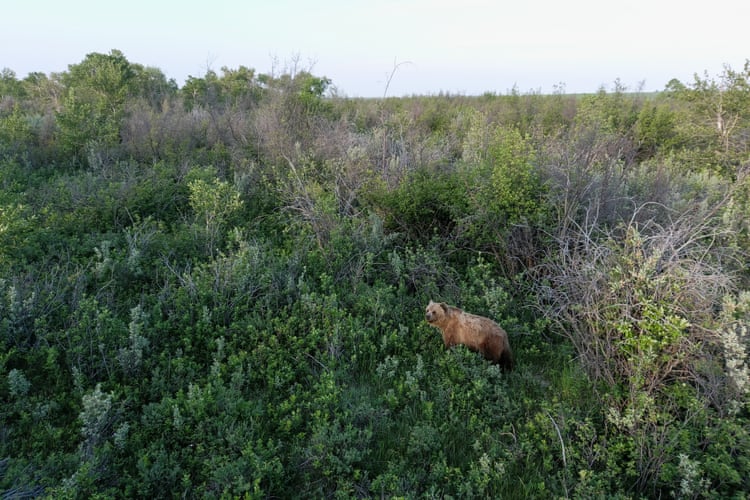
A young female bear caused a stir after wandering out of the forest and into the leafy suburbs of the Lithuanian capital.
For two days, the brown bear ambled through the neighbourhoods of Vilnius, trotted across highways and explored backyards – all while being chased by onlookers with smartphones and, eventually, drones.
The government then issued a permit allowing the bear to be shot and killed if it became aggressive and posed a threat to human life.
That did not go down well with Lithuania’s hunters who, aware that there were only a tiny number of the protected species in the entire country, refused.
The Lithuanian association of hunters and fishermen said it was shocked by the government’s approach.
The association’s administrator, Ramutė Juknytė, said the bear was a beautiful young female who was about two years old and did not deserve to be shot. “She was scared but not aggressive. She just didn’t know how to escape the city but she didn’t do anything bad,” he said.
The organisation tracks the movements of bears. It believes there are only five to 10 bears in the Baltic country but does not have a precise number.
The drama began on Saturday when the bear entered the capital. It was the first time in many years that a bear had entered the city and it became a national story. The animal came within about 2-3 miles (4-5km) of the city centre.
Since causing a stir with their permit to kill the bear, Lithuanian authorities have been on the defensive. The deputy environment minister, Ramūnas Krugelis, said that the kill permit had been issued purely as a precaution in case the bear posed a threat, according to a report by the Lithuanian broadcaster LRT.
The hunters proposed a more humane approach: sedation, tracking and relocation.
As the debate over the bear’s fate unfolded, she took matters into her own paws and wandered out of the city.
Juknytė said the bear was recorded by camera on Wednesday, peacefully wandering through a forest about 40 miles from Vilnius while munching on corn.
Brown bears are native to the region and were once common. They were wiped out in Lithuania in the 19th century as a result of hunting and habitat loss.
In recent years, they have started reappearing in small numbers, typically wandering in from neighbouring countries such as Latvia and Belarus, where small bear populations still exist.
Bears are protected under Lithuanian and EU law as they are considered a rare and vulnerable species in the region.
This article by Associated Press was published by The Guardian on 19 une 2025. Lead Image: The bear was recorded by a hunter in the forest calmly feasting on baits in Pabradė, Lithuania, on Wednesday 28 June. Photograph: Paulius Peciulis/AP.
Wildlife in catastrophic decline
The 73% decline in vertebrate wildlife populations during the last 50 years (mammals, birds, amphibians, reptiles and fish), is primarily driven by human activities that threaten biodiversity.
Habitat Loss and Degradation – human activities like deforestation, urbanization, and agriculture have led to the destruction and fragmentation of natural habitats, reducing the space and resources available for wildlife.
Pollution – air, water, and soil pollution from industrial activities, agriculture, and other sources can harm wildlife directly or indirectly by affecting their habitats and food sources.
Climate Change – changing weather patterns, rising temperatures, and sea levels are disrupting ecosystems and impacting species’ ability to adapt and survive.
Overexploitation of Resources – unsustainable hunting, fishing, and logging practices can lead to the depletion of populations and the loss of biodiversity.
Invasive Species – the introduction of non-native species can disrupt ecosystems, compete with native species, and threaten their survival.
 Donate
Help to protect wildlife by donating as little as $5. Our conservation partners spend at least 80 percent of the money raised on actual fieldwork rather than administration and fundraising.



Leave a Reply