
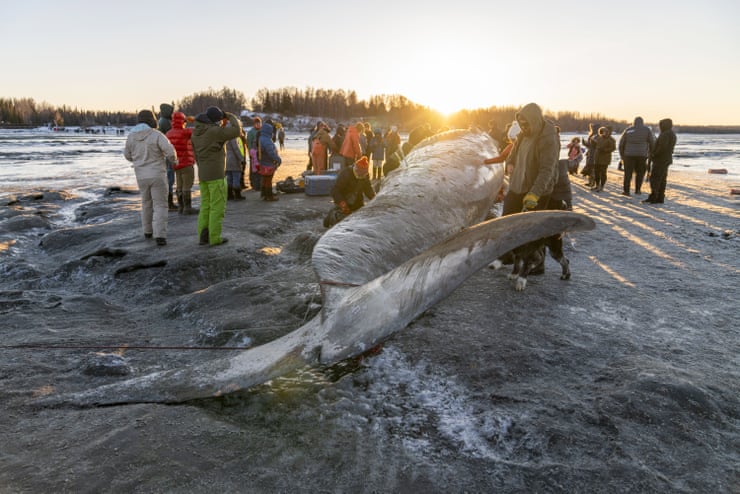
LEYNAR, FAROE ISLANDS – Sea Shepherd has confirmed the death toll from yesterday’s pilot whale hunt in the Faroe Islands (known as the Grindadráp, or “Grind”) has reached 246 individuals, far surpassing the whalers’ initial estimate of 100. Among them were at least 30 pregnant females, whose unborn calves were left to suffocate inside their mothers’ bodies and later discarded in dumpsters.
Crews on the ground documented a killing far more prolonged and chaotic than officially acknowledged. While public statements claimed the hunt lasted only 15 minutes, Sea Shepherd footage shows that the slaughter spanned over 30 minutes—not including the hour of chasing and terrorizing the pod into the shallow waters of the killing beach in Leynar.
Injuries consistent with boat propeller strikes were observed on several of the pilot whales.
Many of the youngest victims—newborns and juveniles—are not considered edible and therefore are not counted in the official kill tally, despite being killed and discarded during the process. A total of 64 young whales have been confirmed so far, but the real number may be higher, as one butchering location remains unaccounted for. The pod was so large that their bodies had to be divided up and sent to at least three different locations for butchering.
Valentina Crast, Sea Shepherd’s Faroes Campaign Manager, made a powerful appeal to Faroese citizens:
“This documentation will serve as critical evidence when we speak to both international and national policymakers. But perhaps more importantly, it’s meant for the good Faroese people who oppose the Grind in silence—because it’s easier not to rock the boat.
What proud hunting practice allows mothers and babies to be slaughtered in great numbers? Who needed this?
Please, don’t stay silent. Say no to this. The ocean and the whales need you to raise your voice.”
Sea Shepherd continues to document the aftermath, including the untracked movement of several transport trucks suspected of carrying more carcasses to an unknown butchering location.
This incident once again raises serious concerns about the cruelty, lack of transparency, and ecological disregard of the Grindadráp tradition. Sea Shepherd calls for immediate international pressure to halt these mass killings and for the Faroese government to recognize the increasing outcry—both abroad and at home.
Sea Shepherd has spent decades defending whales from harpoons—but today that mission must expand. We’re documenting krill trawlers in Antarctica, pushing for bans on whaling, and calling out senseless hunts in places like the Faroe Islands. The threats are evolving—but so are we.
If you’re outraged by what you’ve read, use your voice. Our Faroe Islands Action Toolkit makes it easy to send a message to policymakers and speak out against the slaughter. Every action counts.
This article was first published by Sea Shepherd on 13 June 2025.
Wildlife in catastrophic decline
The 73% decline in vertebrate wildlife populations during the last 50 years (mammals, birds, amphibians, reptiles and fish), is primarily driven by human activities that threaten biodiversity.
Habitat Loss and Degradation – human activities like deforestation, urbanization, and agriculture have led to the destruction and fragmentation of natural habitats, reducing the space and resources available for wildlife.
Pollution – air, water, and soil pollution from industrial activities, agriculture, and other sources can harm wildlife directly or indirectly by affecting their habitats and food sources.
Climate Change – changing weather patterns, rising temperatures, and sea levels are disrupting ecosystems and impacting species’ ability to adapt and survive.
Overexploitation of Resources – unsustainable hunting, fishing, and logging practices can lead to the depletion of populations and the loss of biodiversity.
Invasive Species – the introduction of non-native species can disrupt ecosystems, compete with native species, and threaten their survival.
 Donate
Help to protect wildlife by donating as little as $5. Our conservation partners spend at least 80 percent of the money raised on actual fieldwork rather than administration and fundraising.



Leave a Reply