
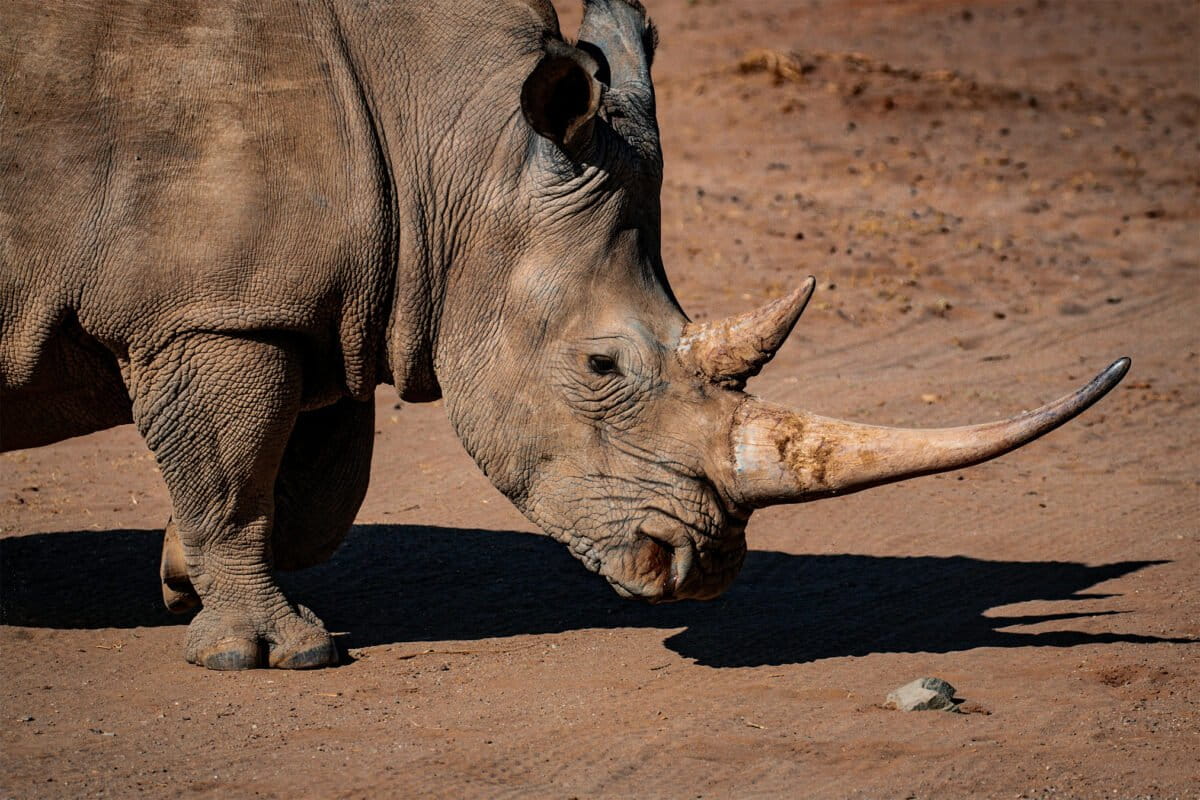
A South African university has launched an anti-poaching campaign to inject the horns of rhinoceroses with radioactive isotopes that it says are harmless for the animals but can be detected by customs agents.
Under the collaborative project involving the University of the Witwatersrand, nuclear energy officials and conservationists, five rhinos were injected in what the university hopes will be the start of a mass injection of the declining rhino population, which they are calling the Rhisotope Project.
Last year, about 20 rhinos at a sanctuary were injected with isotopes in trials that paved the way for Thursday’s launch. The radioactive isotopes even at low levels can be recognised by radiation detectors at airports and borders, leading to the arrest of poachers and traffickers.
Researchers at Witwatersrand’s Radiation and Health Physics Unit said tests conducted in the pilot study confirmed that the radioactive material was not harmful to the rhinos.
“We have demonstrated, beyond scientific doubt, that the process is completely safe for the animal and effective in making the horn detectable through international customs nuclear security systems,” said James Larkin, chief scientific officer at the Rhisotope Project.
“Even a single horn with significantly lower levels of radioactivity than what will be used in practice successfully triggered alarms in radiation detectors,” said Larkin.
The tests also found that horns could be detected inside full 40-foot shipping containers, he said.
The International Union for Conservation of Nature estimates that the global rhino population was about 500,000 at the beginning of the 20th century but has now declined to approximately 27,000 because of demand for rhino horns on the hidden market.
South Africa has the largest population of rhinos with an estimated 16,000 but has high levels of poaching and about 500 rhinos are killed for their horns every year.
The university has urged private wildlife park owners and national conservation authorities to have their rhinos injected.
This article by Associated Press was published by The Guardian on 31 July 2025. Lead Image: A sedated rhinoceros lies unconscious as Prof James Larkin uses a can of identification spray after carefully implanting radioisotopes into its horns, seen with other Rhisotope Project members in Mokopane, South Africa. Photograph: Emmanuel Croset/AFP/Getty Images.
Wildlife in catastrophic decline
The 73% decline in vertebrate wildlife populations during the last 50 years (mammals, birds, amphibians, reptiles and fish), is primarily driven by human activities that threaten biodiversity.
Habitat Loss and Degradation – human activities like deforestation, urbanization, and agriculture have led to the destruction and fragmentation of natural habitats.
Overexploitation of Resources – hunting, fishing and wildlife trafficking lead to the depletion of populations and the loss of biodiversity.
Invasive Species – the introduction of non-native species disrupt ecosystems, compete with native species, and threaten their survival.
Pollution – air, water, and soil pollution from industrial activities, agriculture, and other sources harm wildlife directly or indirectly by affecting their habitats and food sources.
Climate Change – changing weather patterns, rising temperatures, and sea levels are disrupting ecosystems and impacting species’ ability to adapt and survive.
Help to protect wildlife
Help to protect wildlife by donating as little as $5 – it only takes a minute!
 Donate
Our conservation partners spend at least 90 percent of the money raised on actual fieldwork rather than administration and fundraising.




Leave a Reply