
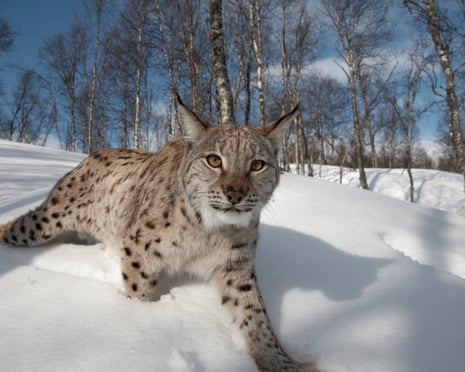
The UK and Ireland are among the few countries in northern Europe without the apex predator the Eurasian lynx (Lynx lynx).
Like most of Britain’s larger native animals, wolves and beavers, it was hunted to extinction, in this case about 1,300 years ago, helping to push the UK towards the distinction of being the most nature-depleted country in Europe.
The campaign to reintroduce lynx into Kielder Forest in Northumberland is gathering momentum and expects a sympathetic hearing from the Labour government, although sheep farmers among others, may hold different views.
The lynx, which has been successfully reintroduced to four European countries while remnant populations survive elsewhere, is basically a big cat weighing a maximum of 25kg, about the size of a springer spaniel.
They hunt at night, and would principally eat some of the overpopulation of roe deer in the Kielder Forest, but would also hunt and eat foxes, hares and rabbits. They are generally regarded as excellent for keeping a healthy ecosystem in balance.
The irony of such introductions is that lynx increase tourism dramatically with visitors hoping to see the wild cat.
However, with the animals so elusive that they have to be fitted with trackers before release to find out where they have gone, this would be unlikely.
This article by Paul Brown was first published by The Guardian on 6 August 2025. Lead Image: A female Eurasian lynx (Lynx lynx) with four kittens in Sweden. The UK and Ireland are among the few north European countries without lynx in the wild. Photograph: blickwinkel/Alamy.
Help to protect wildlife
Help to protect wildlife by donating as little as $5 – it only takes a minute!
 Donate
Our conservation partners spend at least 90 percent of the money raised on actual fieldwork rather than administration and fundraising.



Leave a Reply