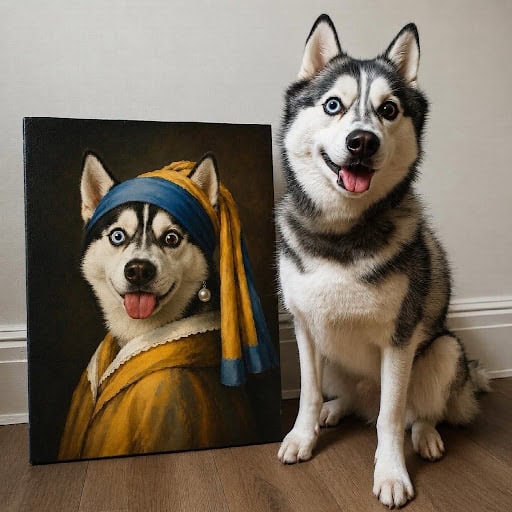
Two dogs can share the same breed, coloring, and approximate size, yet their owners would never confuse them. One waits by the door with a toy in his mouth. The other sits a few feet back, watching until someone reaches for the leash.
Spend enough time with an animal and you begin to recognize these small patterns. You know which sound will make an ear turn. You can predict the sleeping spot they’ll choose at a particular time of day. Even a photograph of the back of their head can feel familiar.
Those details are worth noticing. They help you take more personal photographs, choose artwork that captures a recognizable expression, and remember the ordinary moments that otherwise blur together.
Watch What They Do When Nothing Is Happening
When you reach for your camera, your pet may stop whatever made you want the picture. The cat leaves the windowsill. The dog gets up to investigate what you’re holding.
Try spending a little time watching without asking for anything.
Notice where your pet settles while you cook or work. Watch the sequence of events before a nap: a turn, a stretch, perhaps several attempts to arrange a blanket that looked perfectly comfortable already.
You might spot habits you’ve grown so used to that you barely register them. A dog may rest his chin on the lowest shelf of a bookcase. A cat might wait beside an empty chair until someone pulls it out.
Describe what you actually see before deciding what it means. “She sits beside the cupboard at five” is an observation. “She knows dinner should have been served ten minutes ago” is the household interpretation, however convincing her expression makes it seem.
There’s room to enjoy both, while remembering that an animal’s behavior doesn’t always fit the human story we attach to it.
Look Beyond Coat Color and Breed
Asked to describe a pet, most people begin with the obvious features: a black cat, a golden dog, a rabbit with brown patches.
Recognition tends to become more specific.
Perhaps one ear folds at the tip. The muzzle has gradually turned gray. A patch above an eye gives the impression of a raised eyebrow. When your dog sits, one back leg always seems to escape sideways.
These features can be especially useful when choosing a photograph for a portrait. A flattering image may hide the very thing that makes the face familiar.
Look through several pictures and ask yourself what stays consistent. It could be the shape of the eyes, the angle of the head, or the way the ears sit when your pet is relaxed.
Include changes that belong to their current appearance, too. An older animal doesn’t need to look like their younger self for a picture to be worth displaying. The pale muzzle and slightly untidy fur may be exactly how you know them now.
Take Photos Without Turning It Into a Performance
You don’t need an elaborate setup to photograph those details. A familiar room, soft daylight, and a little patience are a useful starting point.
Choose a place where your pet already feels comfortable. Position yourself near their eye level if you can do so without crowding them. Light from a nearby window can help reveal the face, though you may need to change your angle if one side falls into deep shadow.
Take a few photographs, then pause. Let your pet move away when they want to. Avoid repeatedly calling their name or using noises simply to produce a particular expression.
For a clear reference image, check that:
- The eyes and face are in focus.
- Important markings are visible.
- The camera angle hasn’t exaggerated the nose or shortened the head.
- The original file retains enough detail when you zoom in.
Keep some wider photographs as well. A close-up shows a face; a wider view might include the chair, blanket, or patch of sunlight that belongs to the story.
If your pet dislikes the camera, put it down. Another opportunity will usually arrive.
Turn a Familiar Expression Into a Portrait
A good reference photograph gives a portrait a clear starting point. It shows the features that should survive whatever artistic interpretation you choose.
When considering custom pet portraits, compare examples with the details you care about in mind. Look at the treatment of eyes, ears, markings, and muzzle shape. Decide how much simplification you enjoy before choosing a style.
A loose, painterly image will handle detail differently from a more realistic composition. Either can feel recognizable, but your expectations should suit the approach.
If a preview is provided, review it beside the source photograph. Start with the face rather than the background. Does the expression feel familiar? Is an uneven marking still uneven? Has a distinctive ear been made too symmetrical?
Specific feedback helps. “The dark patch should extend closer to his nose” gives clearer direction than “Something feels wrong.”
You can also supply an additional reference for a feature that’s difficult to see. Ask which photograph should serve as the main image so the instructions remain clear.
Let the Costume Be Imaginary
A portrait can preserve recognizable features while taking considerable liberties with the wardrobe.
That’s part of the appeal of royal pet portraits: a familiar animal appears in clothing far removed from the household where they spend their days. The contrast might suit a solemn dog or a cat whose usual expression already seems appropriate for receiving visitors at court.
Choose the outfit around the face. A high collar shouldn’t conceal an important part of the muzzle, and decorative details should leave enough space for the expression to register. Check that a dark coat remains distinct from the background and clothing.
There’s no reason to put your pet into a physical costume to obtain the reference photograph. A clear image in a comfortable setting is more useful than an elaborate scene in which the animal is distracted or trying to leave.
The finished picture can carry the theatrical idea. Your pet can remain on the sofa, wearing whatever they normally wear.
Keep a Few Stories Alongside the Pictures
Once you’ve chosen a photograph, write down one thing about it.
It might be the name of the walking route, the reason your cat was sitting in that box, or what happened immediately after the picture. A date is helpful, but a few words of context can bring back much more.
Keep the note in a photo album, add it to the digital image description, or write it on a separate card stored with a print. You don’t have to document every week or create a polished scrapbook.
Include the stories that feel too ordinary to mention. Why everyone calls the dog “Inspector.” How the cat acquired a second bed in the kitchen. Which chair became theirs through a process nobody quite remembers agreeing to.
Years later, a beautifully composed portrait may hang beside a slightly blurry photograph. One shows their face clearly. The other reminds you that they used to carry a particular sock through the house every evening.
You’ll probably be glad you kept both.

Leave a Reply