
How do you search for the world’s smallest monkey?
Earlier this year, Nicolás Schuldt Durán took on this task after he was approached by members of an Indigenous community in Ecuador. Ever since, he’s been tapping into the knowledge of the Siekopai people and combining it with passive acoustic monitoring technology to look for pygmy marmosets.
Spoiler alert: They’re still looking for this elusive species.
Working in the Siekoya Remolino community in Ecuador, Durán is collaborating with Indigenous community members to track pygmy marmosets (Cebuella pygmaea), locally called leoncillo, and gather data on where they live and how they’re faring.
“The community has already been setting up camera traps and running a territorial monitoring program to catch hunters and loggers,” Durán, founder of conservation technology organization Neblina Labs, told Mongabay in a video interview. “This is just adding one more tool to their toolkit to monitor biodiversity.”
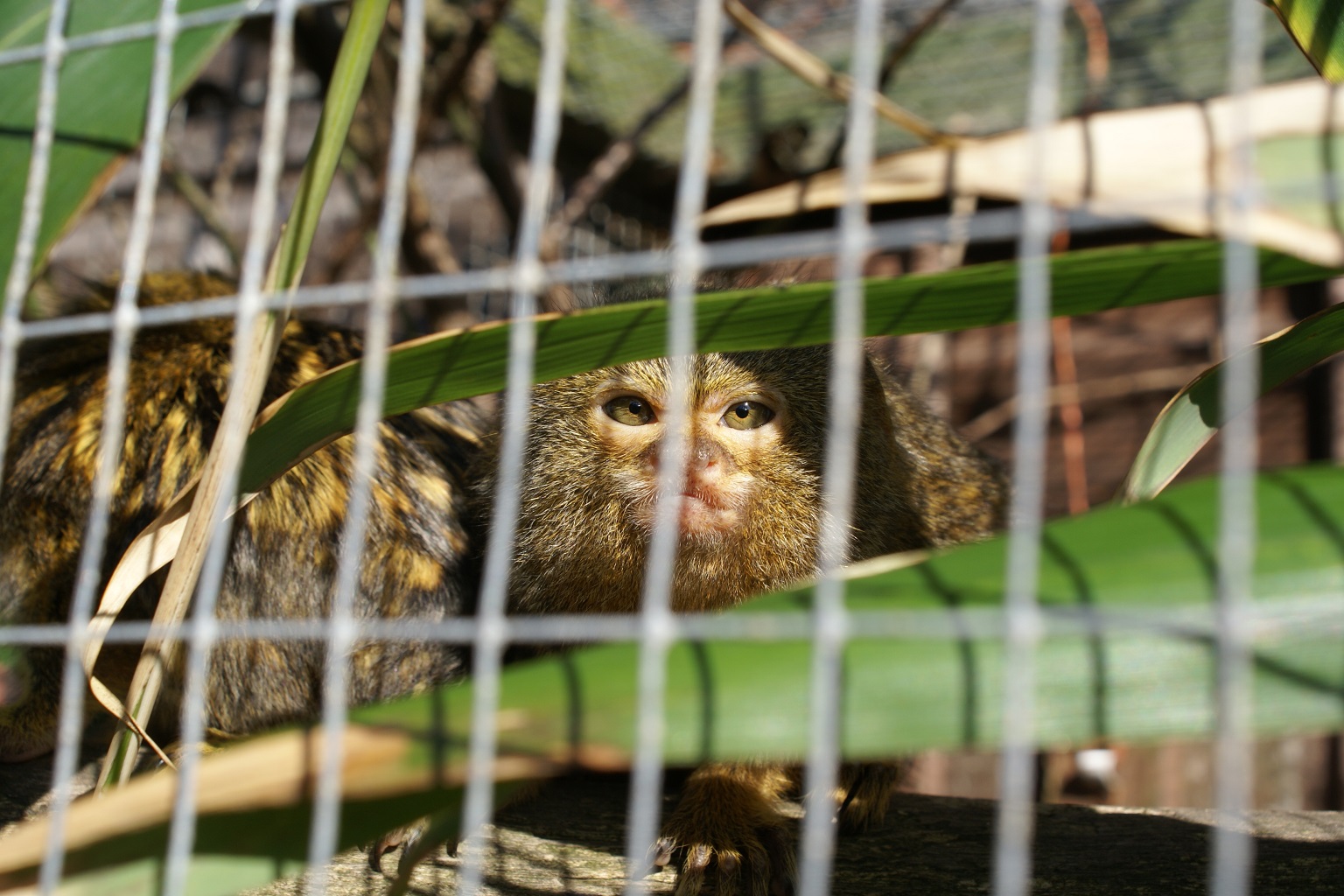
Pygmy marmosets, native to the western Amazon Basin, are so small that an adult weighs only 140-150 grams (about 5 ounces), or the weight of a small apple. They live high up in trees and are known for their high-pitched calls, including whistles that are often in the ultrasonic range and which they use to communicate with one another. Classified as vulnerable to extinction, these primates are threatened by the illegal pet trade as well as deforestation and habitat loss in the Amazon Rainforest.
Since tree gum and sap form a major part of their diet, their populations are massively affected when forests are cut down. As a result, their presence is often considered a good indicator of how forests are faring. “These monkeys are very sensitive to disturbances,” Durán said. “They came up when the communities were telling us about the indicators of good forest health. They said they stop seeing the monkeys when the forest becomes degraded.”
However, it’s often a challenge to visually monitor pygmy marmosets. For one, their size makes it difficult. Moreover, they live high up amid dense vegetation, obscured from the human eye as well as cameras.
Enter passive acoustic monitoring, which involves the large-scale gathering of audio data to detect species living in an ecosystem.
“It has the best bang for the buck in terms of how many species you can hear for the smallest cost,” Durán said.
Earlier this year, he worked with community members to launch a pilot project to detect these monkeys using the technology. They started with a community mapping effort, based on Indigenous knowledge and expertise, which helped identify trees and areas where pygmy marmosets are likely to be found. Durán then deployed microphones to three trees, and left them running for 72 hours.
Upon analyzing the audio recorded by the mics, the team couldn’t detect any pygmy marmoset sounds. However, they detected sounds from other animals, which Durán has used to build detection models for future use.

“We got a good feel of what lives there, what doesn’t, and how diverse this place is,” he said. “It amazes you to see so many lines of the spectrogram. There are sounds everywhere, especially at dawn.”
The search for the world’s smallest monkey, however, continues in full swing.
The community mapping done as part of the pilot project has given the team a good understanding of where they have to look next. Durán said he’s also planning long-term fieldwork to deploy the recorders for a longer time to maximize the chances of capturing the monkeys on tape.
“We will also try to define other indicators in the meantime,” he said. “But our main goal is to find this particular species because it is a great indicator of forest health.”
This article by Abhishyant Kidangoor was first published by Mongabay on 11 September 2026. Lead Image: A pygmy marmoset. Image by Peter Kerrawn via Flickr (CC BY 2.0).
Protect Wildlife Before It’s Too Late
Whether you choose to make a one-time gift or a monthly subscription, you provide the critical funding needed to protect wildlife.
Your immediate support makes a life-saving difference.






Leave a Reply