
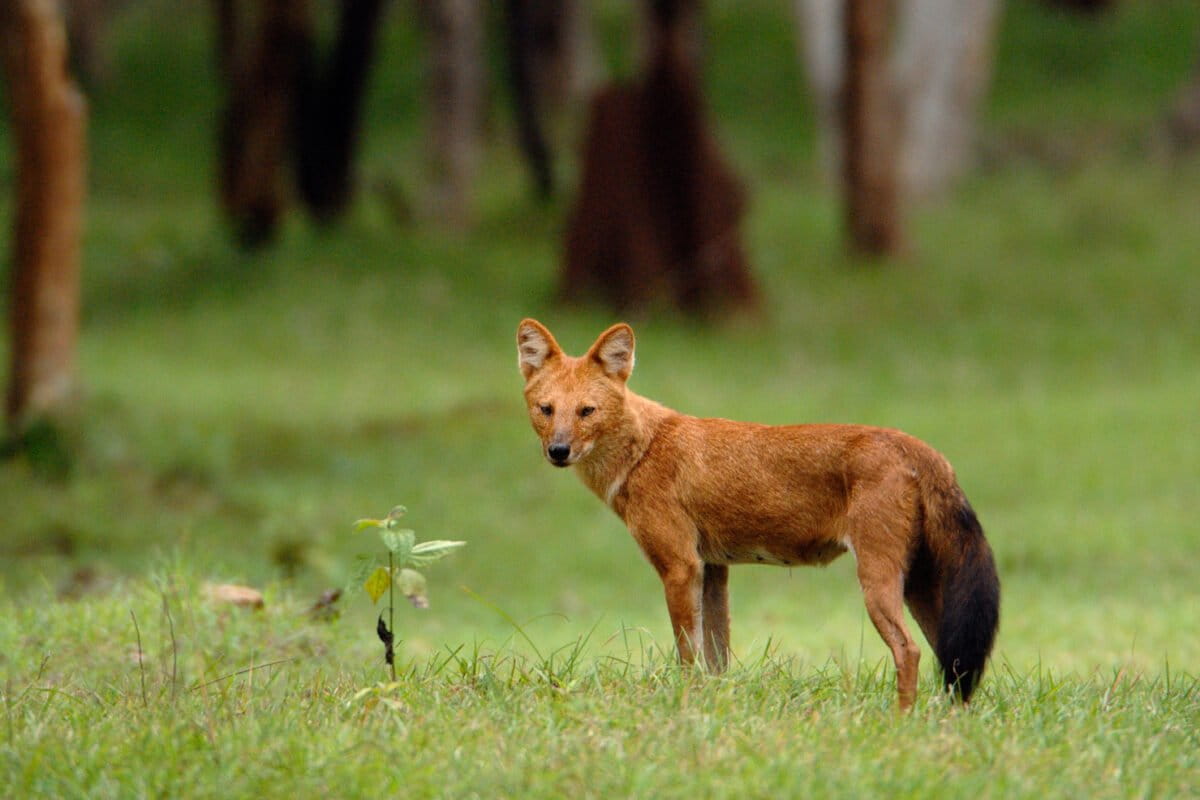
Recent research has confirmed the first sighting of a dhole in more than two decades, a reddish-brown wild dog native to Asia. Before the sighting, the predator was believed to be extinct in Vietnam.
The dhole (Cuon alpinus), historically one of the most widespread large carnivores in Asia, was seen on camera-trap footage. The single adult was spotted in Pu Hoat Nature Reserve in Nghe An province on New Year’s Eve in 2023.
Before this sighting, the IUCN Red List considered the dhole locally extinct.
The find was so unexpected that researchers initially doubted their own eyes. “To be quite honest, before and during the field survey, we did not expect any amazing results,” study author Tuan Anh Nguyen from Vietnam National University told Mongabay. “I really thought I might have a case of a domestic dog… that coincidentally looked somewhat like a dhole.”
The image was eventually verified by four independent biologists.
This documentation followed 49 large-scale surveys and more than 260,000 camera-trap recordings across 31 sites, during which no other dholes were detected.
Despite the sighting, researchers cude theoncl species is likely extirpated across most of Vietnam’s protected areas, primarily due to commercial snaring, a form of industrial hunting that uses wire snares, with up to 10,000 traps. Such traps create a lethal gauntlet for any ground-dwelling species, Nguyen said.
“A wide-ranging carnivore species like a dhole is the most sensitive to snaring, as they themselves are vulnerable to snaring, and their food base is also vulnerable to snaring,” he said. He added that the crisis has already pushed other apex predators, such as the tiger, leopard, and Eurasian golden jackal, into a 20-year silence in the Vietnamese wild.
Co-author Andrew Tilker, from the Leibniz Institute for Zoo and Wildlife Research in Germany, said studies from other ecosystems have shown that the loss of top carnivores can trigger trophic cascades that affect the entire food web, leading to impoverished forests. “We might not see these changes for decades, but they are almost certainly there,” he said.
While a single dhole isn’t nearly enough to be considered a comeback, Tilker said a healthy population would help restore the forest. “Then we can hopefully start to see ecosystem recovery.”
This single dhole, spotted 4.2 kilometers (2.6 miles) from the Laos border, might be a lone wanderer from the neighboring country, but the study said its presence may suggest Pu Hoat is a critical refuge. “It tells us that the site is promising,” Nguyen said, noting that while the population may be tiny, immediate actions to protect the remaining wildlife could be highly beneficial.
For the dhole to truly return, researchers argue that there must be a “holistic approach” that includes improved patrolling, reduced demand for wildlife products, and stronger community guardianship.
This article by Naina Rao was first published by Mongabay on 25 March 2026. Lead Image: A dhole, by Kalyan Varma via Wikimedia Commons (CC BY-SA 4.0).
What you can do
Protect wildlife by making a monthly donation as little as $5.
It only takes a minute!



Leave a Reply