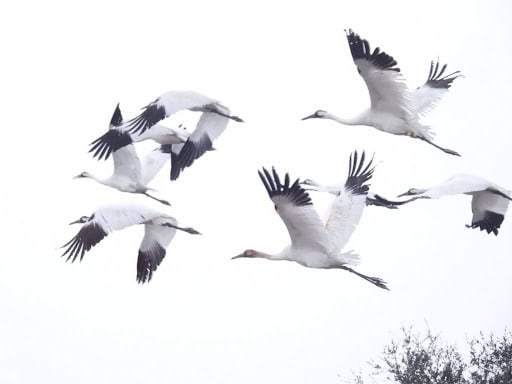

It’s now May and it is too, too quiet without the daily calls of the Whooping Cranes.
Lamar resident and property owner John Sullivan says that it is just too quiet without them visiting his yard – a daily ritual he has grown to cherish since purchasing the property years ago. He reported the Whooping Crane’s last visit to his property this year was on March 26th.
John Sullivan is proud to share that he is addicted to the Whooping Cranes, with countless pictures taken and numerous hours spent watching them as a testament to the addiction.
What is “Addiction”? Addiction describes a physical or psychological dependency or a compulsion to engage in a specific behavior, making it hard to stop. Addiction also refers to having an unusually strong, habitual interest in something.
“Positive addiction”, the term was advanced by William Glasser’s book “Positive Addiction.” In his book, Glasser claims that positive addiction “strengthens us and make our lives more satisfying.”(Article: Are there positive addictions? www.psychologytoday.com)
Bird Watching can be addictive…
A 2022 survey by the U.S. Fish and Wildlife Service, reports that an estimated 96 million U.S. birders spent approximately 107.6 billion on their activities. Find out more here: https://www.fws.gov/story/2024-12/birdwatching-america
The call of the Whooping Cranes,
Once you hear them calling to each other – you will be hooked. It’s a seductive, alluring, hypnotic song that floats through the air, and you just can’t get it out of your head!
It is said you can hear their calls up to 2-3 miles away. The vocalization of the Whooping Crane is described as a clear, loud, bugling “bKAAAH.” (Sibley 2000).
About the Whooping Crane…
According to All About Birds, “The Whooping Crane is the tallest bird in North America and one of the most awe-inspiring, with its snowy white plumage, crimson cap, bugling call, and graceful courtship dance. It’s also among our rarest birds and a testament to the tenacity and creativity of conservation biologists.” Find out more here: https://www.allaboutbirds.org/guide/Whooping_Crane/overview
Whooping Cranes live in the wild across two flyways with two non-migratory populations that live in coastal Louisiana and central Florida. The only self-sustaining population of Whooping Cranes is the naturally occurring flock that breeds in Canada and winters in Texas according to the International Crane Foundation(ICF), a nonprofit organization that is committed to their conservation. https://savingcranes.org/news/resources/where-are-the-whoopers/
The latest survey results from the U.S. Fish and Wildlife Service, indicated a record estimate of 557 whooping cranes wintering on and around Aransas National Wildlife Refuge for the 2024-2025 season.
The Aransas National Wildlife Refuge is best known as the wintering home of the last wild flock of endangered whooping cranes. Visitors can enjoy stunning scenery, a diversity of wildlife, and a variety of recreational opportunities according to their website. Find out more here: https://www.fws.gov/refuge/aransas
Where to find the Whooping Cranes – the Lamar Pasture.
One property the cranes frequent is a pasture between 8th and 12th streets across from the Big Tree and the Goose Island Flats Vacation Rentals that offer a great view of the cranes.
The Lamar Pasture …
In the pasture is a pond where the Whooping Cranes and Sandhill Cranes gather. The birds can be seen chasing each other or dancing among the grazing cattle and sharing a drink of water with other native birds like Roseate Spoonbills, Ibis, Egrets, Great Blue Herons and Whistling Ducks, to name a few. Drought has impacted the level of the water in the pond.
Curiously, the Whooping Cranes and Sandhill Cranes have discovered that many Lamar homeowners have deer feeders that throw dried corn. Like clockwork the birds fly from house to house, much like children trick-or-treating, their calls can be heard-almost like a shout, give us something good to eat! Rather smart perhaps, I mean, why pass up a treat!
My addiction to the Whooping Cranes began years ago…
I first started watching the Whooping Cranes while living in Rockport, Texas – over thirty years ago before moving to San Antonio to be closer to family.
Living in Rockport’s coastal Birding community, you can see an abundance of birds as you travel the roads that offer scenic views of the ocean, a Blue Wave Beach, fishing and so much more! Learn more here: https://www.rockport-fulton.org/birding/
My return – making the rounds, literally!
February 2026 was my first return to Lamar in a number of years. I drove down Main Street, passed a familiar landmark-Pop’s Place, heading towards a birdwatcher’s Paradise. A dopamine rush came over me and I wanted to drive faster, but…I plead the fifth!
I drove eagerly around about a 2-mile loop of roads that include 4th St, 8th St, and 12th St to Palmetto and Lamar Beach Road. I passed the Big Tree and a couple peddling city bikes down Palmetto for the third or fourth time. I waved at them, again-grinning like a “Cheshire Cat”, and a thought came to mind. I was either crazy or addicted to the Whooping Cranes.
The good thing is that I am not alone in the addiction!
Come quick they said and the dopamine surged!
A phone call from a friend lured me to the shoreline of Saint Charles Bay where cars parked haphazardly and a group of “Bird Watchers” stood on a narrow patch of grass, cameras and binoculars in hand ready to capture pictures or a view of a pair of Whooping Cranes feeding in the water.
Unfortunately, I was only able to take two pictures before the birds flew off-ugh!
I continued around the bend in the road, where I met Barbara Beversdorf in the parking lot of the Big Tree at the start of the “Golden Hour.” The trees illuminated in the glow of that familiar warm, soft light many have come to appreciate. We parked and stood cameras in hand as we waited for the cranes to fly over on their nightly return to the Aransas Wildlife refuge. It was by the Big Tree right before sunset that I met Sara Zimorski and Lea Noble.
The Big Tree…
The Big Tree at Goose Island State Park-a popular tourist spot, is one of the largest live oak trees in Texas and in the nation. Learn more here: https://tpwd.texas.gov/state-parks/goose-island
The area around the Big Tree, according to legend and word of mouth, served as a ceremonial place for Indigenous people for thousands of years. I wonder if perhaps the cranes gather nearby because of their internal compass or if they see it as a familiar landmark.
Meet some of the Whooping Crane Addicts…
Bird Watcher and photographer Barbara Beversdorf,
I met Barbara Beversdorf over a decade ago at Landa Park in New Braunfels, Texas, while photographing migratory waterfowl. Landa Park is fed by the Comal Springs, which are the largest natural freshwater springs in Texas and the American Southwest.
Barbara and I began our Whooping Crane journey together when an opportunity to visit the now closed Crane House B&B in Lamar presented itself. We jumped at the chance to watch and photograph the endangered birds. Barbara and I would spend the next several Christmas holidays photographing the Whooping Cranes at the Crane House.
During our February visit, after driving around Lamar in search of a photo opportunity and reminiscing about our bird watching adventures, Barbara shared her thoughts with me. “There is a special kind of joy in watching and photographing Whooping Cranes. It’s not just their beauty that stops you; it’s the knowledge of how close we came to losing them forever.”
“Every call and every movement captured in a picture or video is a reminder of what can be saved when people choose to care. Standing there, in those moments, I can’t help but feel grateful to share the space with something so rare.” Barbara Beversdorf .
As we waited in the parking lot of the Big Tree, Sara Zimorski walked past me toward an army green truck with a circular Louisiana Wildlife and Fisheries Emblem on the door.
Me being me, I had to say hello, along with – I guess you are here for the Whooping Crane festival?! Silly question, I’m sure! (https://www.portaransas.org/whooping-crane-festival/the-2026-festival/)
Sara Zimorski,
Sara, traveling all the way from Louisiana, is a Wildlife Biologist with the Louisiana Department of Wildlife and Fisheries (LDWF) who works with Whooping Cranes.
According to their website, “The Louisiana Department of Wildlife and Fisheries(LDWF), in partnership with Audubon Nature Institute and others, has been reintroducing endangered whooping cranes to Southwest Louisiana since 2011 to establish a self-sustaining, non-migratory population. Located at White Lake Wetlands Conservation Area, the project has released over 100 birds, with around 80 residing in Louisiana’s marshlands and working wetland agricultural properties as of 2025.” Instagram@lawhoopingcranes. Follow them here: https://www.facebook.com/lawoopingcranes/
After a few minutes, photographer Lea Noble drove up and parked next to us. We introduced ourselves, and excitedly began to discuss a plan of action, where to stand, any lighting concerns to try and capture a decent photograph of the cranes as they fly by. Of course, all we would need is for them to fly near where we were parked – fingers crossed!
Photographer Lea Noble…
Lea shared with us that she is a Wildlife Photographer traveling to Texas from Arizona to see the Whooping Cranes. When Lea pulled out her camera, I think I drooled. How in the world can she hold that big camera with that BIG lens that would make anyone jealous!
I learned that Lea’s photography has appeared in photographic journals, wildlife education magazines, and lifestyle publications. See her photography here: https://www.leanoble.com
Professional wildlife photographer Lea Noble shares her thoughts,
“The Whooping crane is one of the most elegant and graceful birds I’ve ever seen. They dance, defend their young with great fierceness, and travel thousands of miles for love.”
“Their past…when they were nearly lost – reminds us that what happened to them could happen to any species. They are a powerful lesson in why we must protect wildlife.”
John Sullivan’s addiction to Whooping Cranes…
It was in February when I was introduced to John Sullivan. John has property the Whooping Cranes visit while they spend the winter in Texas, and he has no shame in sharing what he calls his “addiction” to the cranes.
“I am addicted to the cranes and can’t get enough of them! They bring me joy and I consider the Whooping Cranes to be one of the best forms of medicine for the soul.” John Sullivan
John Sullivan – Addicted to Whooping Cranes
John first read about the plight of the Endangered Whooping Cranes when he was in the fourth grade – about 1955. John was born and raised in Manchester, Connecticut.
He was drafted during the Vietnam era and after nine months of electronic schooling, he was stationed at Castle Air Force Base in Atwater, CA where he met and married his wife of 56 years-Jo Leanne or “Jo” for short!
Once John had served four years in the military, he attended college to earn a teaching credential with a major in mathematics. John taught for thirty-nine and 1/2 years. Since he liked challenges, he taught various grades, from kindergarten, fourth and sixth grade to middle school. When he retired from the Atwater Elementary School District, he taught courses dealing with mathematics to elementary school teachers for nine years at Merced College.
When he retired from teaching all together, John and “Jo” moved to Missouri where they built a lodge and log cabin near Branson. After living there for four years, they moved to Lamar, Texas in 2021.
The property met all their requirements for living – acreage, water, on the coast and wildlife, mainly Whooping Cranes which now have become an integral part of their lives.
John rises early each morning before sunrise, walks outside, and takes a seat in a chair strategically placed on his driveway, camera in hand-he waits like an expectant father.
Living with cancer,
John was recently diagnosed with cancer and is currently receiving cancer treatment. John talks about how the cranes have helped him get through the cancer treatment.
The calls and beauty of the cranes help to distract his mind and redirect his attention from the many side effects that can be associated with cancer treatment.
John doesn’t miss a morning watching the cranes arrival to his property if he can help!
“The Whooping Cranes are amazing creatures! If we lose nature we lose us!” John Sullivan
The Benefits of Bird Watching…
“As a mindfulness activity, bird-watching has holistic healing properties, bird-watchers say.” According to one article I discovered by Kati Blocker, UCHealth discusses the healing properties of Bird Watching.
“At UCHealth Cancer Center in northern Colorado, patients are given the tools and resources to incorporate mindful bird watching as a supplement to their cancer treatment and other mindfulness-based stress reduction offerings.” Read the full article here: Mindfulness activities in nature: Try bird-watching: http://www.uchealth.org/today/mindfulness-activities-try-bird-watching//
“It is not just about watching wildlife – it is about being drawn into a movement so pure, so unfiltered that you leave changed. These Whooping Cranes don’t perform, they don’t notice the clock-they simply live, and for a while, they allow us to be a part of their life!” John Sullivan
Saying goodbye,
As I made my way out of Lamar to head home, I stopped to fill up on gas at a local convenience store. I noticed the SUV next to me had a license plate with BIRDS brightly displayed and I had to say hello and ask if she was in town to see the Whooping Cranes.
While I pumped gas into my car, I struck up a conversation with Diane Crookham-Johnson. I learned that she is from Iowa, and was in town to see the Whooping Cranes, and does she have a story to share with me about her journey with the cranes.
Diane Crookham-Johnson from Iowa…
Diane shared with me how she found her way to Lamar and the Whooping Cranes.
“Birding generally started as a hobby after my husband was routinely traveling for work and our children left home for their adult lives. I had a life-long photography hobby. Bald Eagles became a new focus for my camera. A Yellow Warbler in a bush near my parking spot one day in 2018 started what would become a passion for birds.”
“In 2020 I headed to Nebraska to learn about wildlife photography during the Sandhill Crane migration. Covid-19 interrupted my workshop, but my introduction to cranes stuck! The mass number of birds, the large size of bird that allowed great observations, the historic significance of the migration, and the united efforts of so many people and organizations to support the migration along the Platte River captured my heart. Later I would be drawn back time and again because of the impact I observed amongst people observing the Sandhill Cranes from bird blinds and along gravel roads and the impact my own observations had on me. It is not an exaggeration to say I need to spend time each season with cranes to renew my own soul.”
“Each trip to Nebraska for Sandhill Cranes meant more stories about Whooping Cranes. Whooping Cranes were a bird I had never observed.”
“In summer 2022 I ventured to nearby Wisconsin to see Whooping Cranes in captivity. I knew then I had to see Whooping Cranes living in the wild on their own terms.”
Diane shares more about her journey, “A first trip in early 2023 to the Aransas National Wildlife Refuge area was my first chance to see the wild flock of migrating Whooping Cranes. The weather was more Iowa winter than Texas winter, the waterways were covered in fog, but that first glimpse of Whooping Cranes foraging for blue crabs hooked me.”
“Since then, multiple trips back to Texas have resulted in an affinity with the largest of birds in North America. Once a nesting bird in Iowa, my home state, and nearly extinct by the early 1940s, I developed an appreciation for their strong desire to live and thrive.”
Diane continues, “I was in awe of the Whooping Crane’s commitment to their family units, their skills as parents, and their wherewithal to complete a 2,500-mile migratory trip twice a year.”
“In Fall 2025 I completed a trip to Saskatchewan, Canada to view Whooping Crane families as they left their breeding grounds and fueled up for the migratory trip south to Texas. I was fortunate to observe a banded family with a colt in Canada and then four months later in Texas. Oh, how the colts grow!”
“And again, my soul was renewed. The magnificence of the Whooping Cranes, the commitment of the people and organizations supporting everything it takes to keep Whooping Cranes on this Earth, the spirit of the people gathering to observe the cranes combines to create an energy that convinces me anything is possible and will be achieved. As I drive home from Texas to Iowa, I am convinced that we saved the Whooping Cranes so that they could save us.” See her photos here: Instagram: dianecjphotos
The countdown begins as soon as they leave…
John’s countdown for the return of the Whooping Cranes to Lamar begins as soon as they leave Texas. Migrating about 2500-miles to the Wood Buffalo National Park in Canada along the “whooper highway,” a crucial corridor for their survival according to the International Crane Foundation(ICF).
Without people like us with a “positive addiction” to birds, many species, like the Whooping Crane could have been left to become extinct.
The recent killing of a Whooping Crane at a Louisiana Crawfish farm led to two workers being cited for violating the Migratory Bird Treaty Act. The fines appear more like a slap on the wrist. That should be a catalyst for change!
In the words of Sir David Attenborough, “No one will protect what they don’t care about; and no one will care about what they have never experienced.”
Without protection like the Migratory Bird Treaty Act, the work of State Agencies, the Bird Watchers, the Whooping Crane Addicts, Researchers and Scientists, Nature lovers and organizations like the ICF, we might not have these beautiful birds in the future. Please consider learning more, doing more, joining the club – be a Whooping Crane Addict!

Alesia Garlock
Wildlife / Environmental Advocate! I fight to protect nature. Informing the public of hidden agenda!




Leave a Reply