
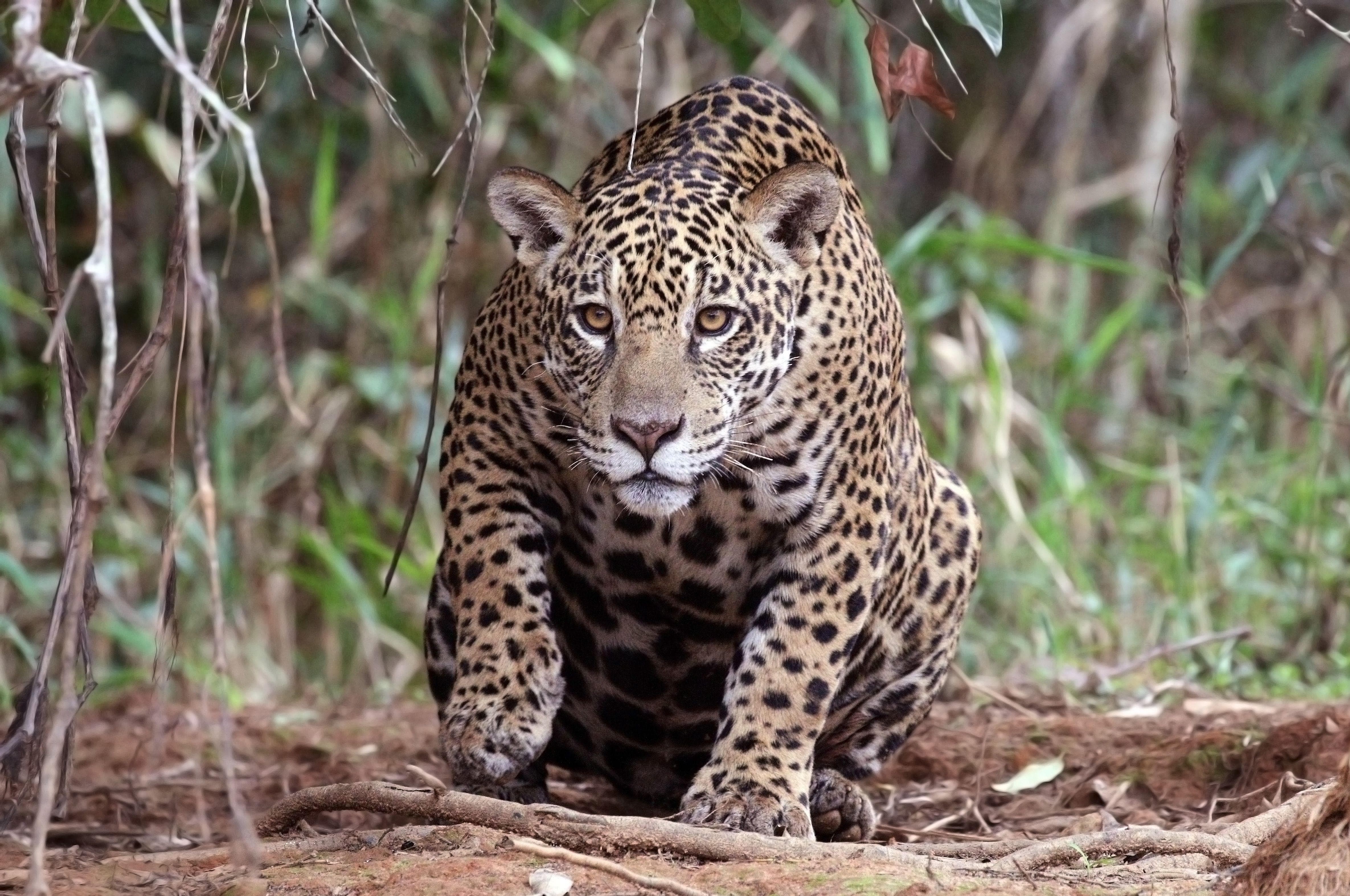
Conserving the dwindling jaguar population in Brazil’s Atlantic Forest won’t be possible without protecting its prey. That’s the conclusion of a new study, which found that the absence of deer, peccaries and other animals that sustain these big cats is driving it toward local extinction.
Jaguars (Panthera onca) once ranged from the southwestern U.S. to Argentina and is the Western Hemisphere’s largest cat. Today it’s locally extinct or imperiled across much of its former territory, including the Atlantic Forest biome where it’s critically endangered.
In this region, the study notes, some 85 % of jaguar habitat is gone and only small fragments remain within what’s considered one of the world’s most degraded tropical forests. As a result, jaguars have declined dramatically here, especially over the past two decades.
The new study highlights one reason why: There’s not much for them to eat. Medium and large prey have diminished greatly, including white-lipped peccaries (Tayassu pecari), collared peccaries (Dicotyles tajacu), brocket deer (Mazama spp.) and tapirs (Tapirus terrestris).
“We are facing a silent extinction of prey species in the Atlantic Forest,” says study lead author Katia Ferraz, a wildlife biologist at the University of São Paulo. “We talk a lot about jaguar extinction, but we talk little about the extinction of peccaries and deer, for example, that are important prey.”
Ferraz and her colleagues assessed jaguar prey species in nine protected areas in the Atlantic Forest. To do so, they carried out the most extensive camera-trap survey ever conducted in this biome. They found the highest abundance of prey species in the so-called Green Corridor area straddling the Brazil-Argentina border, an area with a smaller human presence and the highest numbers of jaguar. By comparison, coastal Atlantic Forest areas had little prey and few — or no — jaguars.
It’s the first estimate of its kind for the Atlantic Forest and the protected areas that span the best remaining fragments of the biome, Ferraz says. She calls the absence of wildlife “alarming.” Illegal hunting is likely the main cause of dwindling prey.

Empty forests
Fewer than 300 jaguars remain in the Atlantic Forest biome, a fragmented corridor running along Brazil’s Atlantic coast, according to current estimates. Those populations are scattered. The largest is in the Green Corridor, about 100 cats; other populations are smaller, numbering in the 20s or even less. This leads to inbreeding and imperils their ultimate survival.
“If you have a population of 20 individuals, the viability in the long term is practically zero unless we do something,” said study co-author Adriano Chiarello, a biologist at the University of São Paulo.
In the Atlantic Forest, deer and peccaries make up a large percentage of the jaguar’s diet. These same species are also targeted by hunters for bushmeat and local trade, Chiarello said.
In recent surveys, researchers found low numbers of white-lipped peccaries, deer and other key prey species in Atlantic Forest protected areas. Video courtesy of Katia Ferranz.
“Without a healthy natural prey base, jaguars can turn to feeding on domestic animals like livestock — increasing conflict and direct retaliation from humans, thereby increasing the chances for local extinction of jaguars,” said Allison Devlin, who directs the jaguar program at wild cat conservation nonprofit Panthera, who wasn’t involved in this research.
Declining prey could also limit natural dispersal of these cats, which must strike out and find their own territory when they leave their mother at 18 months to 2 years of age. Without adequate food, there’s little chance that jaguars will recolonize forest fragments, regardless of whether they’re connected, the authors say. Even in areas with a higher abundance of prey, such as Brazil’s Serra do Mar mountains, the prospect of jaguar presence is low because connectivity is limited.
“This study highlights a critical but often overlooked driver of top predator decline: the loss of their food due to poaching,” said Mauro Galetti, a professor at São Paulo State University, who wasn’t involved in the paper. “Most of Atlantic Forests are effectively ‘empty,’ lacking the medium- and large-bodied prey for jaguars.”
“Without sufficient prey biomass, jaguars cannot persist, regardless of habitat protection,” he added. “This is a super important and needed paper to call attention to the protection of the whole ecosystem.”

Camera trap film of a jaguar and its cub in the Atlantic Forest. Video courtesy of Katia Ferranz.
Protecting prey, improving the landscape
These findings underline the need for a landscape-level conservation approach that moves beyond just conserving the big cat but incorporates broader efforts necessary to protect a large, wide-ranging predator like the jaguar.
That means restoring connectivity, particularly along rivers, and protecting prey — notably deer and peccaries — by reducing hunting pressure. That must include community engagement with people living near protected areas as well as support for alternative livelihoods, Ferraz said.
“If you can protect the jaguar in a larger landscape, this means this larger landscape is a much better, healthier … landscape [ecologically speaking],” Chiarello said. That should include buy-in from the agricultural sector to improve lands set aside under Brazil’s Forest Code, he added. “If we don’t improve the current quality of the protected areas, this species will not survive.”
Increasing prey numbers in these remaining forests is crucial, which means tackling hunting may also require restoring prey where it’s absent, either by reconnecting these lands or by translocating animals from elsewhere.
“If we give jaguars the space and resources they need to survive, they can persist,” Devlin said. She pointed to an example in Honduras, where conservationists successfully reintroduced collared peccaries to Jeanette Kawas National Park after they were hunted out.
Ultimately, Ferraz said, their paper highlights the fact that both predator and prey must be protected to maintain balance within the fragile Atlantic Forest ecosystem.
“Without prey, there are no jaguars,” she said. “If we don’t stop this process now, we will lose the jaguar, as well as several other terrestrial mammals in the Atlantic Forest.”
Citation:
Ferraz, K. M., Paolino, R. M., Fusco-Costa, R., Sampaio, R., Almeida, A. B., Bogoni, J. A., … Chiarello, A. G. (2026). The loss of prey base may drive the jaguar (Panthera onca) toward extinction in the Atlantic Forest of South America. Global Ecology and Conservation, 66, e04084. doi:10.1016/j.gecco.2026.e04084
This article by Sean Mowbray was first published by Mongabay on 8 April 2026. Lead Image: Lack of prey in Atlantic Forest protected areas could drive local extinctions of jaguars, a recent study warns. Image by Gregory Slobirdr Smith via Flickr (CC BY-SA 2.0).
What you can do
Protect wildlife by making a monthly donation as little as $5.
It only takes a minute!



Leave a Reply