
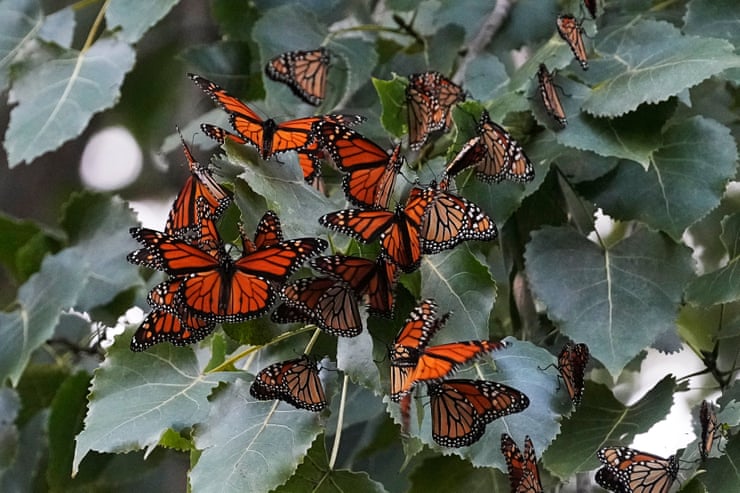
The monarch butterfly (Danaus plexippus) population has plummeted by 80% to 95% since the 1990s, depending on the region and monitoring method. A major cause of the species’ decline is deforestation in central Mexico, where eastern monarchs spend the colder winter months of their annual migration from Canada and the northern United States.
Since 1980, the Mexican government has worked to conserve critical winter monarch habitat by cracking down on logging, one of the leading causes of habitat degradation. They ultimately designated 563 square kilometers (217 square miles) of forest as the Monarch Butterfly Biosphere Reserve, banning logging, hunting, and foraging in certain locations and restricting it in others.

The project has yielded mixed results for the habitat, however, with logging continuing in some areas despite the prohibition. To understand why, a team of researchers studied the protection of the forest with a focus on how the involvement of the local communities affected conservation outcomes in the Reserve over a 50-year period. The study, published in Environmental Conservation, demonstrates that community buy-in can make or break a conservation project.
“People must be consulted in order for the conservation strategy to be successful,” said study co-author Gustavo Cruz-Bello, an ecologist and social scientist at the Metropolitan Autonomous University in Mexico City.
The Reserve represents a complex web of human and natural interdependence. Monarchs rely on the oyamel fir forest in the mountains of the Michoacán and Edomex states for survival. The region has become warmer and drier, and the trees, which thrive in cool, moist temperatures, now only grow high up in the mountains. The monarchs, who also need cooler temperatures to slow their metabolism and store energy, depend on the fir trees, which prevent the butterflies from freezing by acting as a protective layer against dangerously cold temperatures and precipitation.
The human inhabitants of the Reserve area also rely on the forest. Most of the land is part of La Hacienda watershed. Prior to the Reserve designation, the locals living in the watershed communally managed parcels of land called ejidos. The stewards of these parcels, ejidatarios, had legal rights to use this land and profit from it, but did not own it. Many of them made their living through forestry.
Using aerial and satellite photography of forest cover from 1971 to 2021, the researchers analyzed the impact on logging of three separate protection decrees levied on the land in the Reserve during that time. They established five categories of forest cover on a spectrum from healthy, unlogged forests, to poorly conserved, highly logged forests. They assigned categories to photos based on the number of trees they were able to count in each one and then reviewed how the forest cover changed with time.
Counterintuitively, the most severe logging happened after conservation orders were announced. During two time periods, between 1984 and 1994 and between 1994 and 2004, the photographic timeline showed forest degradation outpacing recovery. In 2010 field interviews, ejidatarios said that without alternative income sources, they cleared more trees ahead of the 1986 and 2000 conservation decrees to earn money while they still could. All told, 43% of the fir forest within the Reserve was lost in the 50-year study period, primarily to illegal logging.
But the study didn’t reveal total devastation of the habitat. Overall, deforestation exceeded reforestation by 6%, but parts of the forest cover did become denser — and healthier for the monarchs.
“If we just look at deforestation, it’s easy to get very depressed,” said Kathy Baylis, an agricultural economist at the University of California, Santa Barbara, who researches land management in the Reserve, but was not involved in the study. “But the fact that they’re actually seeing some success in terms of reforestation, I think is quite hopeful.”
A turning point came in 2004, after the roll-out of national programs that paid ejidatarios to refrain from logging and conserve the forest by repurposing abandoned agricultural land for forestry and replanting trees. Compensation provided them with a modest replacement income and sense of cooperation with the government toward the shared goal of conserving the forest, according to interviews. Investment in people and their wellbeing, along with stricter enforcement, natural regeneration, and enhanced tourism, the authors concluded, turned the tide from forest disturbance to recovery toward the end of the study period.
“We’re imposing costs on the communities to provide that biodiversity,” Baylis said. “Shouldn’t we compensate them in some way?”
Citation:
López-García, J., Cruz-Bello, G. M., & Manzo-Delgado, L. de L. (2025). Protecting forests, losing trees: the role of community involvement. Environmental Conservation, 1–10. doi:10.1017/S0376892925000128
This article by Claudia Steiner was first published by Mongabay on 3 December 2025. Lead Image: Monarch butterfly resting on a plant. Photo by José López-García.




Leave a Reply