
The U.S. issued more than 300 elephant trophy import permits during the first year of President Donald Trump’s second term, according to records obtained by U.S.-based NGO the Center for Biological Diversity (CBD). It’s the most ever issued on Trump’s watch in a year, and indicates that as many as 300 elephants were killed. Trophies are usually the taxidermied heads or feet, which hunters display in their homes as décor.
Tanya Sanerib, the center’s international legal director who analyzed the data, called the permit numbers “alarming.” It’s a 154% increase in the total number of elephant trophy import permits issued during all of Trump’s first term.
Because elephants are listed as threatened under the U.S. Endangered Species Act (ESA), importers need a permit from the U.S. Fish and Wildlife Service (USFWS) to bring elephant trophies into the country. In 2018, the agency issued 114 permits. That dropped to just four in 2019 and none in 2020 and 2021.
Receiving a permit does not necessarily mean an elephant was killed that year. Some hunters apply for permits before going on a hunting trip; others apply after an animal is killed. Each permit is valid for a year.
African savanna elephants (Loxodonta africana) are an endangered species. In the 1800s, about 26 million roamed the continent. But poaching for the international trade in ivory crashed their numbers: Since 1965, 60% of them were slaughtered for their tusks.
Only about 415,000 remain today. While the ivory trade has declined, this wide-ranging pachyderm’s habitat continues to shrink. It’s lost as much as 80% of its former territory to farms, ranches, mining operations and other human development. There’s also conflict with people: When elephants raid crops or enter villages in search of food, they’re often killed in retaliation.

Botswana tops the list of elephant trophy exports
The U.S. is the world’s largest importer of hunting trophies of all kinds. More than 72,600 mammals listed under CITES, the international wildlife trade convention that regulates trade in endangered plants and animals, were killed and brought into the country between 2014 and 2018, according to a report from Humane World for Animals (previously called Humane Society International). About 10,000 of those imported as trophies are listed as threatened or endangered under the ESA in the U.S.
Southern Africa is a top destination for hunters who pay to kill the choicest animals. “With so many trophy hunters coming from the United States, our government should be helping to police the trophy trade, but Trump officials are instead rubberstamping imports of tusks and heads,” Sanerib said.
According to her analysis, nearly two-thirds of the imported elephant trophies came from Botswana, followed by Zimbabwe and Namibia. Botswana is home to the world’s largest elephant population, about 140,000. It reopened elephant trophy hunting in 2019, after a pause of five years. Recent surveys show elephant numbers are stable overall in the country, but are declining in areas where hunting is permitted.
Reports question benefits of trophy hunting
Botswana’s government has long defended its decision to reinstate hunting as a way to deal with increasing elephant numbers and rising human-elephant conflicts, and says that hunting also provides livelihoods. In 2024, Botswana’s President Mokgweetsi Masisi famously offered to send 20,000 elephants to Germany after Berlin suggested imposing stricter limits on trophy hunting imports.
In 2025, the government permitted the hunting of 410 of its elephants, and increased it to 430 this year.
Trophy hunting is a pursuit for the wealthy, who parachute into the country — often from the Global North, with many from the U.S. — and pay up to $28,500 just to kill an elephant. This fee, also called the trophy fee, is determined by professional outfitters, based on market demand and licensing fees. Data collected by Humane World for Animals show that a 14-day luxury hunting excursion, including trophy fees, accommodations, food, a professional guide fee and other costs in Botswana could run as much as $87,000 for elephants with sizeable tusks.
Along with the hunters, most of the people associated with the industry are also foreigners: hunting outfitters, lodge owners and landowners, among others. Research from Botswana shows that foreign-owned safari companies and investors dominate the country’s tourism industry. They take most of the profits, while locals are left scrambling for low-paying jobs. It’s a similar story in other Southern African countries, such as Namibia.

“The international trophy hunting industry acts as a veritable wealth and resource drain in many instances throughout Africa to foreign-owned hunting outfitters and private landowners,” said Sarah Veatch, wildlife policy principal at Humane World for Animals. “This destructive, unjust system is driving the killing of elephants for the sake of a trophy, prioritizing elitist international demand over equitable, community-centered conservation.”
A 2023 independent investigation by journalist Adam Cruise found elephant trophy hunting did “not provide any meaningful income for any of the rural communities” in Botswana. Most funds remained with wealthy hunting operators. Cruise also found that killing elephants for money did not mitigate conflicts with the pachyderms.
Politicians in Botswana accuse the government of being influenced by the U.S. pro-trophy hunting lobby and raised questions over whether these organizations have played a role in drawing up hunting quotas.

Botswana’s hunting numbers unsustainable, scientists say
Some scientists argue that taking out about 0.3% of the population each year is unsustainable. One important reason is that trophy hunters target larger, older bulls or elephants with big tusks, called supertuskers. Half of all mature bulls in the population where hunting is permitted will end up being shot for sport under current quotas, according to an analysis by Botswana-based NGO Elephants Without Borders.
Mature bulls are vital in elephant societies, where older animals pass on their knowledge to the young. Killing them also hurts breeding and genetic diversity, as big tusks disappear from the gene pool, Sanerib said.

In addition to shrinking habitats, poaching and retaliatory killings, Botswana’s elephants face another threat: changing climate. As one of the world’s most drought-prone countries, Botswana declared recent years as “extreme drought.” In 2024, 350 elephants died after drinking water poisoned by toxic algal blooms; scientists say the bloom was exacerbated by climate change.
Scientists argue that Botswana did not consider these impacts on elephants when arriving at the current hunting quotas. “Our models show that current quotas of 0.3% result in a relatively small pool of mature bulls and a population that is sensitive to increases in mortality from drought or poaching,” the Elephants Without Borders report said. It recommends limiting trophy hunting to a maximum of 0.2% of the total population per year, which would mean cutting the current quota by a third.
Increase in permit numbers a ‘policy failure’
The steep increase in import permits issued under the current Trump administration is in sharp contrast to the president’s expressed views on trophy hunting. In a social media post in 2017, Trump called it a “horror show” and said he’d be “very hard pressed” to change his mind about how killing helps conservation in any way.
In 2018, media reports revealed that the administration had formed an advisory board, the 16-member International Wildlife Conservation Council, to promote big game hunting and rewrite federal rules on importing the heads and skins of threatened species, including lions, rhinos and elephants.
Conservation groups filed a lawsuit, charging that government agencies had “flagrantly violated federal law by appointing a council packed with trophy hunters, firearm executives and representatives of businesses with close ties to the Trump administration.” Four members were donors who solicited millions for Trump’s campaign. In February 2020, the board was disbanded

Trump’s eldest son, Donald Jr., is known to be an avid trophy hunter who has killed animals around the world. Photos have surfaced over the years of him and his brother, Eric, posing with dead animals, including a leopard, a Cape buffalo and a crocodile, among others. A 2019 hunt of an endangered Argali sheep in Mongolia reportedly cost U.S. taxpayers more than $75,000 for Donald Jr.’s Secret Service protection.
When a species is listed under the ESA, the USFWS is obligated to protect it. That includes spending public money for conservation efforts. Trophy hunting is permitted under Section 10 if it increases the overall survival of the species. Whether trophy hunting, an industry rife with corruption, actually does that, and who it ultimately benefits, is hugely contested.
In 2024, the U.S. strengthened its regulations on elephant trophies to ensure the money from killing animals benefits conservation. This is a tall ask for an agency that lost 18% of its staff last year in government layoffs, according to a source who previously worked at USFWS in a leadership capacity and spoke on condition of anonymity.
Issuing permits to kill ESA-listed animals is a “policy failure,” Sanerib said. “Permitting this activity, to my mind, doesn’t align with the provision in the law.
In May 2025, Safari Club International (SCI), a U.S.-based pro-hunting organization, petitioned the USFWS to roll back some protections for African elephants under the ESA so it would be easier to import trophies.

The petition calls the current regulations “unnecessary, overly burdensome and inconsistent with regulatory reform initiatives” under Trump, and urges the agency to accept the exporting countries’ determination that trophy hunting does not harm the species.
“It would be a scenario akin to the fox guarding the hen house,” Sanerib said. “If [Safari Club International’s] petition was implemented, USFWS would no longer be required to determine that import of a sport-hunted trophy enhances the survival of African elephants.”
It also means that hunters would no longer need an ESA permit to import their elephant trophies.
As of now, it’s unclear how the Trump administration will handle this petition, Sanerib said. “We are keeping a careful watch for any updates.”
Citations:
Mbaiwa, J. E. (2017). Poverty or riches: Who benefits from the booming tourism industry in Botswana? Journal of Contemporary African Studies, 35(1), 93-112. doi:10.1080/02589001.2016.1270424
Kalvelage, L., Diez, J. R., & Bollig, M. (2020). How much remains? Local value capture from tourism in Zambezi, Namibia. Tourism Geographies, 24(4-5), 759-780. doi:10.1080/14616688.2020.1786154
Lomeo, D., Tebbs, E. J., Babayani, N. D., Chadwick, M. A., Gondwe, M. J., Jungblut, A. D., … Songhurst, A. C. (2024). Remote sensing and spatial analysis reveal unprecedented cyanobacteria bloom dynamics associated with elephant mass mortality. Science of The Total Environment, 957, 177525. doi:10.1016/j.scitotenv.2024.177525
Peyman, A. J., & Styles, M. A. (2024). Examining the influence of corruption on the practice of trophy hunting in South Africa. Conservation, 4(4), 577-593. doi:10.3390/conservation4040035
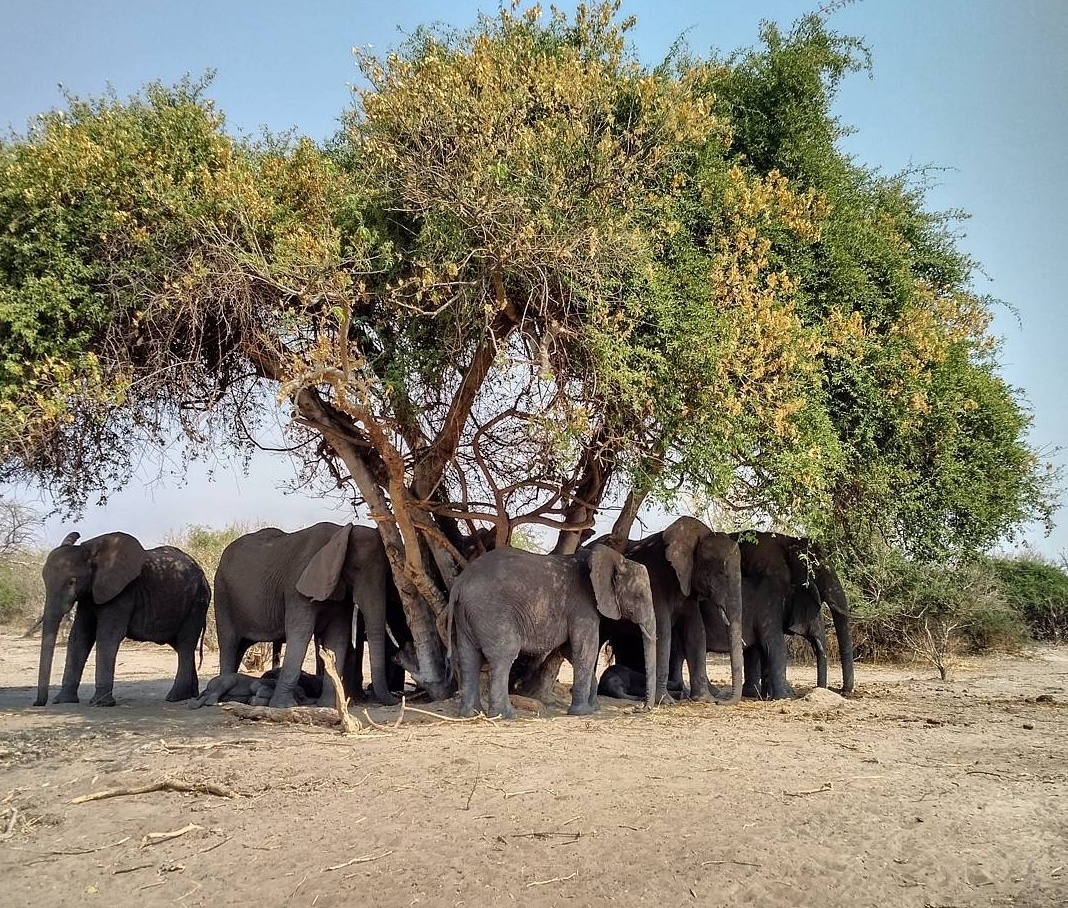
This article by Spoorthy Raman was first published by Mongabay on 18 May 2026. Lead Image: African savanna elephants are endangered, after years of poaching for their ivory decimated their numbers. Now, their habitats are fast-shrinking due to human activities. Image © mariedelport via iNaturalist (CC BY-NC 4.0).
Help to protect wildlife
Protect wildlife by making a monthly donation as little as $5.
It only takes a minute!




Leave a Reply