
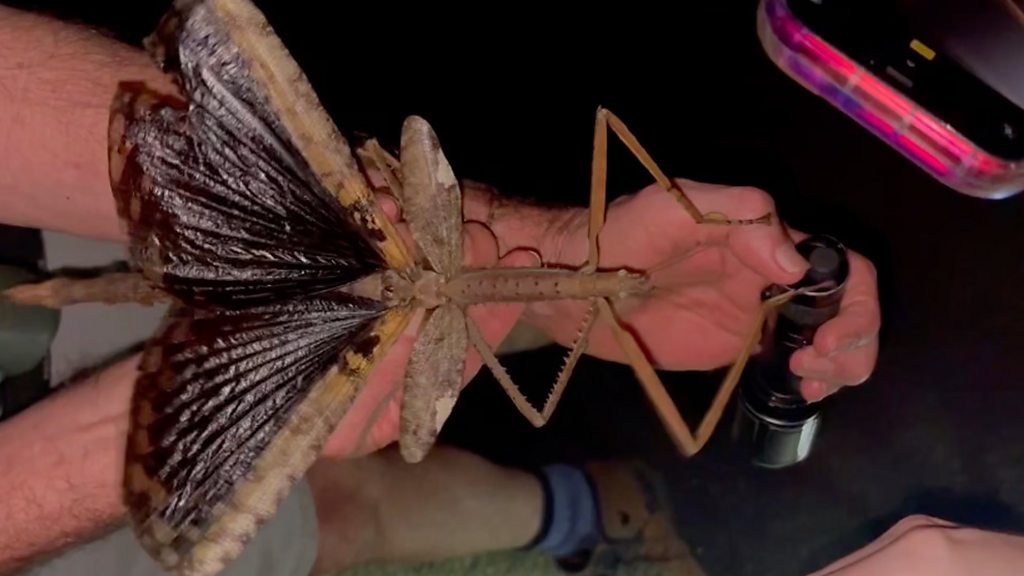
Stick insects (Goliath pictured) have long stick-like bodies that grow up to 50cm in length. Their bodies resemble leaves, sticks or grass, which makes them extremely good at camouflage. They usually have two pairs of wings, but some species are wingless.
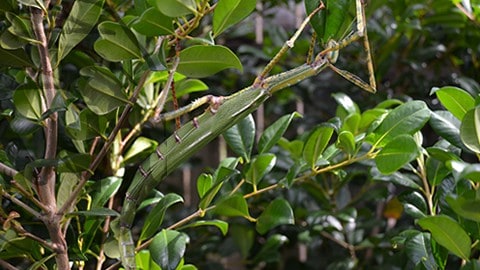
There are over 2500 species throughout the world and counting, with 150 represented well in Australia. Stick insects are herbivores and they are fastiduos with their food.
With an interesting biology females lay eggs one at a time, flicking then to the ground. Between 100 and 1,300 eggs are laid in a female life- time of one year. Stick insect eggs are generally oval, and superficially seed- like with an amazing array of textures and ornamentation. Many also resemble tiny urns with lids, and are very attractive to ants. When egg is taken back to an ants nest, the nutritious capitulum (the lid) is eaten and the egg is discarded. This benefits the stick insect eggs as it helps egg dispersal, with eggs buried in ant nests having a lower rate of parasitism from native wasps. Egg incubation varies significantly with some hatching within a few weeks with others remaining dormant for years.
Stick insects are a tasty snack for many animals such as birds, possums, lizards, frogs, spiders and green ants. With so many enemies, stick insects developed some unique defences. Camouflage and randomly dropping to the ground and stay motionless to avoid getting eaten. Some will kick with their spiky legs, flash brightly coloured wings and make hissing sounds to scare away an enemy. Stick insects occasionally drop off one or more of their legs to escape a predator (much like a lizard & geckos loosing their tail in the same manner).
Asian people consider them as good luck insects, some keeping them in their house, however they don’t do good pets, obviously.
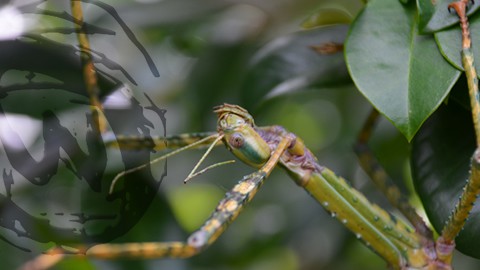
In north Queensland the Peppermint Stick Insect Megacrania batesi with an average length of 10cm shoots a jet of white liquid from the back of its thorax into the face of an attacker. So handle with care this one and wear goggles and keep your mouth shut.
It can squirt this liquid over 20cm, the white substance will burn the eyes and cause temporary blindness. The liquid smells exactly like peppermint toothpaste, but I doubt it will taste the same!

Alberto Vale
Alberto Vale is an award-winning wildlife filmmaker, cinematographer, naturalist and citizen scientist based in Cairns, North Queensland, at the gateway to the Wet Tropics World Heritage Area. For more than two decades, Alberto has combined wildlife cinematography with an intimate knowledge of tropical habitats, guided by a simple principle: to film wildlife successfully, you must first understand its habitat and behaviour. As founder and President of the Australian Quoll Conservancy (AQC), he has spent more than a decade conducting non-invasive field research on the endangered northern spotted-tailed quoll, developing non-invasive techniques to identify and monitor individual animals, breeding and behaviour without conventional trapping. Through WildCAM Australia®, Alberto has produced and directed internationally broadcast natural-history documentaries, including Green Tree Ants – Friend or Foe?, Quolls: Fast & Furious, and his latest production, Quollity Breeding, narrated by veteran Australian voice-over artist Katherine Kennard. Today, Alberto continues to combine cinematography, natural history and citizen science, using the camera not simply to capture wildlife, but to reveal behaviour, contribute to conservation knowledge and bring the hidden lives of Australia's native species to audiences worldwide.



Leave a Reply